
Your needs, this model
Does it fit your priorities?
Is the 10,000-BTU/h SACC tier enough for your cooling need?
The exact sheet lists 10,000 BTU/h SACC and estimates coverage up to 550 square feet; it does not guarantee performance in a particular room.
Explore this need in the finder →Must the same portable AC provide heat as well as cooling?
Yes. AP1022HW1GD is a separately coded heat-pump configuration; its exact sheet lists four modes. Heat output and minimum outdoor temperature are not provided here.
Explore this need in the finder →Can you install and use two exhaust ducts rather than one?
The exact sheet lists two 5.9-inch by 59-inch ducts. This is not the one-hose AP1022CW1G setup.
Explore this need in the finder →Will the uncut panel arrangement span your measured opening?
Hisense lists vertical slider openings 25–50 inches and horizontal slider openings 18–50 inches; measure the opening orientation and both duct route.
Explore this need in the finder →Can you move an 80-pound unit and kit into place?
The exact sheet lists 80 pounds with kit included; the manual recommends two or more people for moving and installation.
Explore this need in the finder →Can you route the supplied drain hose when using Heat mode?
The family manual lists a drain hose and clip for heat-pump models and instructs users to connect it for Heat. No low-ambient limit is documented.
Explore this need in the finder →Is a built-in lift pump essential for your condensate route?
No built-in pump is confirmed. A drain hose is supplied for Heat mode; a general-mode continuous pump route is not documented.
Explore this need in the finder →Does an exact EnergyGuide CEER minimum matter to your choice?
The model-specific sheet prints CEER 7.83, but exact EnergyGuide values were not reviewed. If a label threshold is essential, this evidence is insufficient.
Explore this need in the finder →Will the listed parts-and-labor warranty duration meet your minimum?
The exact sheet lists two years for parts and labor; it does not promise a claim outcome or seller service.
Explore this need in the finder →Must heat-pump operation be documented down to a particular outdoor temperature?
No ambient-temperature range is listed in the exact sources reviewed. Do not use this model to meet a numeric outdoor limit without a separate confirmation.
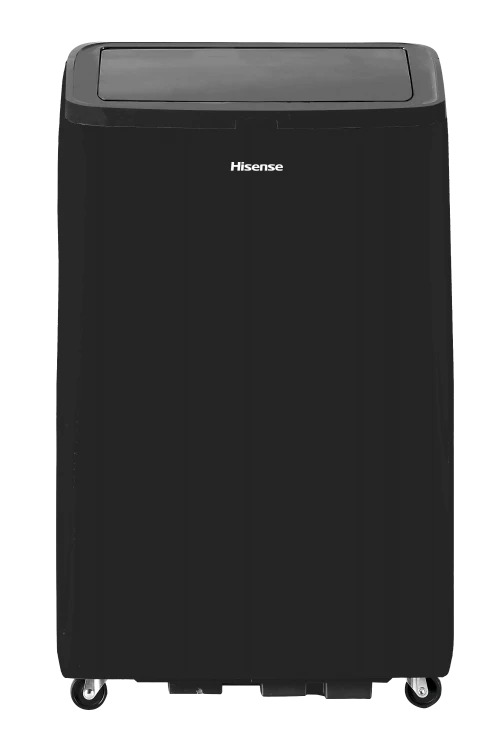
Explore this need in the finder →The Hisense AP1022HW1GD is the heat-pump configuration in the AP1022 family: the exact U.S. specification sheet lists 10,000 BTU/h SACC, a manufacturer estimate up to 550 square feet and two exhaust ducts. Unlike the cooling-only AP1022CW1G, this code documents heat. It is also distinct from AP1022TW1GD; similar capacity or a shared manual does not make those codes interchangeable. Consider it only if a portable unit that cools and provides heat is useful, and you can plan both its paired ducts and its heat-mode drain hose.
What the 10,000-BTU rating means
Hisense publishes 10,000 BTU/h SACC and up to 550 square feet for this model. The area is a maker estimate, not a promise for a sunlit top floor, a high-ceiling room, or a connected space with open doors. The model-specific sheet's cooling table and its dual-duct layout are a better starting point than treating the headline as a guarantee. There is no published heating BTU figure or outdoor-temperature operating limit in the sources reviewed here, so the heat-pump mode should not be selected on the assumption that it can replace a primary heater in every winter condition.
The official sheet lists four modes—Cool, Heat, Dehumidify and Fan—and the product page promotes ConnectLife with Google and Alexa compatibility. An included remote is listed too. The control convenience is useful if you want app access, but it does not change the venting or room-load calculation. Dry mode is for moisture removal, not a substitute cooling mode; the manual explicitly distinguishes it from cooling. No separate independent noise, cooling or heating test was conducted for this assessment.
Two ducts change the window plan
The exact sheet identifies a double-duct arrangement with two 5.9-inch hoses, each 59 inches long. That is a different installation from the one-hose CW1G: the second duct and its window openings need space, and both hose connections must reach the supplied slider panel without a stretched or obstructed route. Hisense lists the panel for vertical sliders 25 to 50 inches wide and horizontal sliders 18 to 50 inches high. Measure the opening and the path before moving an 80-pound kit-included appliance into position. The cabinet itself is 17.40 inches wide, 28.27 inches high and 14.69 inches deep.
The 21-page Hisense family manual is named for AP1022HW1GD and AP1022TW1GD; its cover has a generic model line, so I use it only for applicable shared instructions, not to transfer the other model's features. It lists two exhaust hoses, a window kit, a remote and—in heat-pump models—a drain hose and clip. Its installation drawings show the paired ducts, and it says to connect the drain hose when using Heat. If that hose cannot be routed to a suitable lower drain, the heating plan is not a fit. The manual also describes draining the unit before storage and gives a full-container warning; “drain-free” in promotional copy should not be read as “never needs a drain.”
Setup and ownership are part of the decision
Plan for an 80-pound appliance before delivery. Hisense's manual recommends two or more people to move and install it. The sheet lists 115 volts, a 4.9-foot cord and an LCDI plug; the manual calls for a grounded three-prong outlet on a 15-amp time-delay circuit and warns against an adapter or extension cord. Its printed page 5 shows 20-inch hose/window-door placement; printed page 6 separately says to allow at least 20 inches of air space on all sides for best performance. Plan for both, along with the opening, outlet and duct path.
The sheet names R32 refrigerant. The manual includes flammable-refrigerant precautions and says servicing should be handled by appropriately trained technicians. It lists a washable, removable filter; clean and dry it as directed instead of treating maintenance as optional. Those are practical ownership constraints, not evidence of unusually easy long-term upkeep.
Useful published details—and limits
The exact sheet lists a 50–53 dB(A) sound range, airflow of 165–215 CFM, 79.2 pints per 24 hours of dehumidification at the printed 26.7/19.4°C condition, and a two-year parts-and-labor term. These remain manufacturer specifications rather than measured room results. It also prints CEER 7.83, but that is not a verified EnergyGuide value; keep label-based CEER and annual-use figures unknown unless the exact label is obtained. The sheet says “Timer: NO,” while the shared manual depicts a timer remote. As the manual covers more than one model, timer availability remains unconfirmed for this exact configuration.
Who should keep it on the list?
Shortlist AP1022HW1GD when 10,000-BTU/h SACC is adequate for the real room, both ducts fit the window arrangement, app/remote control is welcome, and heat is valuable with a routed drain hose. It is a poor match when you need one hose only, cannot move 80 pounds, require a documented heating output or low-ambient limit, need heating without a drain hose, or need a verified EnergyGuide minimum or condensate pump. If heat is unnecessary, the reviewed AP1022CW1G is the separate single-hose cooling-only option; for a higher cooling SACC tier, compare AP1222CW1W, which is also single-hose and cooling-only. Neither comparison makes room estimates a substitute for sizing the actual space.
Sources: Hisense's AP1022HW1GD product page, model support page, exact-model specification sheet and family use and installation manual. The manual names both HW and TW models; the EnergyGuide's numeric values and some manual-versus-sheet control details remain unresolved.
Key details at a glance
| DOE seasonal-adjusted cooling capacity | 10000 BTU/h |
|---|---|
| Manufacturer's stated room area | 550 sq ft (stated, not a guarantee) |
| Documented modes | cool / heat / dry / fan |
| Dual-hose exhaust arrangement | Yes |
| App or connected control | Yes |
| Manufacturer's lowest sound claim | 50 dBA (claim, not our measurement) |
| Cabinet width | 17.4 in |
| Cabinet height | 28.27 in |
| Cabinet depth | 14.69 in |
| Listed product weight | 80 lb |
| Listed limited warranty | 2 years |
| Window-kit minimum width (where exact manual confirms) | 18 in |
| Window-kit maximum width (where exact manual confirms) | 50 in |
| Supplemental heat documented | Yes |
Use the exact model’s instructions for operating limits, supplied equipment and version differences.
Sources for this assessment
- Hisense AP1022HW1GD U.S. product page observation (rendered/indexed page, not original HTML)
- Hisense AP1022HW1GD exact-model support page observation
- Hisense AP1022HW1GD Release specification sheet
- Hisense AP1022HW1GD/AP1022TW1GD use and installation manual
- Hisense U.S. Energy Guide index observation
- Hisense AP1022HW1GD support-page-linked product image
Keep the model number in the decision.
Check the listed suffix, included vent kit, room conditions and service instructions before ordering.