
Your needs, this model
Does it fit your priorities?
Does AP0722CW1W meet the cooling threshold I need?
Its exact model sheet lists 7,000 BTU/h SACC. It meets a 6,000-BTU/h minimum but not a higher 7,100-BTU/h choice.
Explore this need in the finder →Will AP0722CW1W fit a measured slider opening at an endpoint of its manual panel range?
The linked instructions describe 18–50 inches for a vertical slider width or horizontal slider height. The panel configuration changes by opening size; verify the drawings and do not extrapolate beyond that range.
Explore this need in the finder →Can I require app control without accidentally selecting a heater?
Hisense lists ConnectLife app control for this model, but the configuration is cooling-only. It can fit an app-required cooling shortlist, but the same unit must not be used to satisfy an essential heat requirement.
Explore this need in the finder →Does AP0722CW1W add heat to cooling?
No heat mode is listed for this model; its three documented modes are Cool, Fan and Dehumidify. A heat-essential request should reject it.
Explore this need in the finder →Can AP0722CW1W drain condensate continuously without a lift pump?
Hisense describes self-evaporation in ordinary use, but the linked instructions permit a gravity hose from the upper drain port for Dry/Dehumidify in high humidity. That port is not used in Cool or Fan, and no integrated pump is documented.
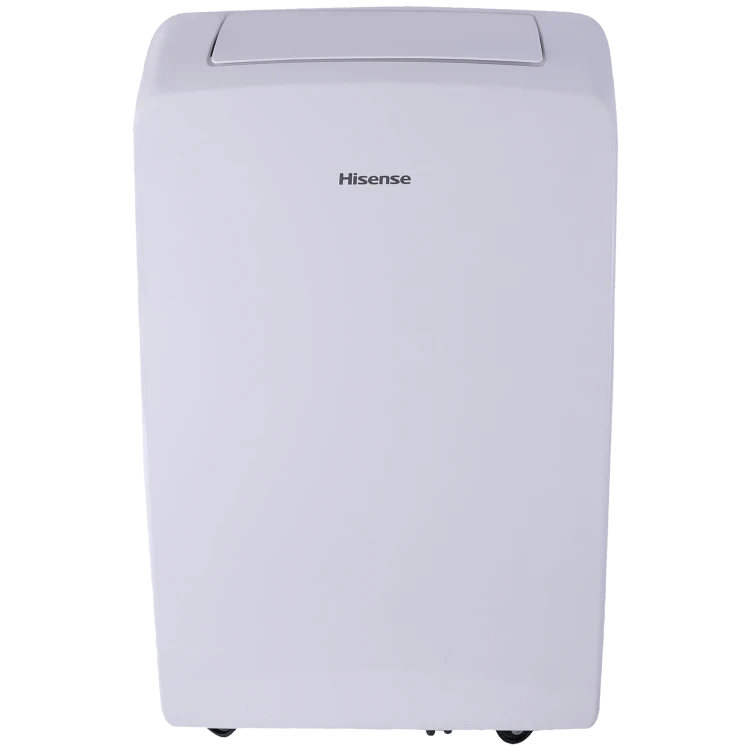
Explore this need in the finder →The AP0722CW1W is an earlier Hisense portable AC with 7,000 BTU/h of DOE/SACC cooling capacity, a single exhaust hose, and ConnectLife app control. Hisense’s page title still says “250 SF,” while the model-specific sheet and the body text estimate up to 300 square feet. I use the exact sheet’s 7,000-SACC rating and its 300-square-foot estimate, but treat the area as a starting point rather than a promise. A sunny top-floor room, leaky windows, high ceilings, or an open doorway can overwhelm a portable unit rated for the same nominal area.
Where the 7,000-SACC tier makes sense
This model is worth comparing when you want more than a compact 5,000- or 6,000-SACC portable AC but do not need the 8,000-SACC level of its sibling, the AP0822CW1W. The 7,000-BTU figure is SACC, not a larger ASHRAE headline; use the DOE/SACC number when you compare cooling capacity across portable models. In the finder, it clears a 6,000-BTU minimum but not a 7,100- or 8,000-BTU minimum. Its room label should not override that distinction.
Hisense lists Cool, Fan and Dehumidify operation, with no heating mode. Fan circulates room air without cooling it; Dehumidify is a different use case from trying to lower the room temperature. The product page describes a self-evaporating, drain-free approach for ordinary operation, but the manual still includes a lower drain for emptying water when needed and an upper drain port for Dry mode in high humidity. That is gravity drainage, not a built-in pump. If you want to run Dry mode for long periods, make sure you can place a hose below the unit and route the water to a drain, bucket or outside without kinks. The manual says the upper port is not used in Cool or Fan mode.
Plan the hose and the opening before moving it in
The included design is single-hose: one flexible duct sends condenser heat out through the window panel. It is not a dual-hose unit with a separate outdoor intake, so do not choose it if an independent intake/exhaust arrangement is essential. The linked Hisense instructions prohibit extending, replacing or modifying the hose, advise keeping the exhaust path short and unblocked, and call for at least 20 inches of open space around the appliance for airflow. The hose is listed as 59 inches long. Treat that as a layout constraint; a farther window or several tight bends can turn a workable room into a poor installation.
The manual’s panel system is described for vertical sliders 18 to 50 inches wide or horizontal sliders 18 to 50 inches tall. Measure the clear opening rather than the sash’s outside frame. The kit uses different panel combinations across that span, so check the installation drawings for your exact opening. This range does not prove compatibility with casement, awning or unusually shaped windows. Hisense also says to plug the appliance into a grounded three-prong outlet, not to remove the ground pin, and not to use an adapter or extension cord. The unit is heavy enough that the manual calls for two or more people to move and install it; the specification sheet lists 58.4 pounds with kits included.
One physical detail deserves extra care in a tight nook. The AP0722 sheet gives metric cabinet dimensions of 433 × 708 × 320 mm, but the inch triplet printed alongside those numbers does not convert to the same size. The values converted from the metric row are about 17.05 × 27.87 × 12.60 inches. Because that source conflict is real, do not rely on a fractional-inch clearance from a listing alone; verify the cabinet dimensions on the exact carton or model documentation before ordering for a narrow space.
Connected control, maintenance and limits
Hisense lists ConnectLife app control and compatibility with Alexa and Google Assistant, as well as an included remote and a washable, removable filter. This makes it more convenient than a basic panel-only unit when you want to adjust settings without crossing the room. It does not turn a single-hose portable AC into a central system: it cools the room where it is installed, and the app does not resolve poor hose placement or an undersized room plan. Hisense’s specification sheet gives a 49–52 dBA range; that is a manufacturer figure, not a measurement from an independent room test.
The two AP0722 specification-sheet revisions disagree about whether the unit has a timer, while the linked family-use manual illustrates timer control from the remote. I do not treat a timer as confirmed for this exact configuration. If scheduled start or stop is essential, confirm the supplied remote and control panel for the exact model before choosing it. The same caution applies to a hard efficiency target: the model sheet lists CEER 6.9, but no annual household bill can be predicted from that number alone. Room load, runtime and electricity rate still matter.
How to choose between AP0722 and AP0822
Choose the AP0722CW1W when its 7,000-SACC tier, lower listed weight and 300-square-foot manufacturer estimate fit the room better than a larger unit. Step up to the AP0822CW1W if you need the documented 8,000-SACC tier and its 350-square-foot estimate; that sibling is heavier and lists a slightly longer exhaust hose. Both are earlier single-hose, cooling-only options with app control, a 18–50-inch panel span, and similar water-management caveats. If heating, a pump-based drain, or a dual-hose setup is non-negotiable, neither should remain on the shortlist. Check current availability and the exact model label before purchase; older-model references are not a stock promise.
Sources: Hisense’s AP0722CW1W product page, model support page, specification sheet and linked use and installation instructions. The specification sheet and product page describe the cooling level and room estimate; the manual’s drainage, hose and window guidance informs the setup tradeoffs above.
Key details at a glance
| DOE seasonal-adjusted cooling capacity | 7000 BTU/h |
|---|---|
| Manufacturer's stated room area | 300 sq ft (stated, not a guarantee) |
| Documented modes | cool / dry / fan |
| Dual-hose exhaust arrangement | No |
| App or connected control | Yes |
| Cabinet width | 17.05 in |
| Cabinet height | 27.87 in |
| Cabinet depth | 12.6 in |
| Listed product weight | 58.4 lb |
| Listed limited warranty | 2 years |
| Window-kit minimum width (where exact manual confirms) | 18 in |
| Window-kit maximum width (where exact manual confirms) | 50 in |
| Built-in condensate pump | No |
| Supplemental heat documented | No |
Use the exact model’s instructions for operating limits, supplied equipment and version differences.
Sources for this assessment
- Official Hisense product and support pages for exact AP0722CW1W (web-index observation; not raw HTML)
- Official Hisense support page for AP0722CW1W, page-title/model and linked manual/image source
- Hisense-authored exact AP0722CW1W specification sheet (manufacturer asset)
- Hisense product-page-linked use and installation instructions listed for AP0722CW1W
- Exact AP0722CW1W white product image linked from its Hisense support page
- Earlier Hisense-authored AP0722CW1W specification-sheet revision, retained because it conflicts on timer status
Keep the model number in the decision.
Check the listed suffix, included vent kit, room conditions and service instructions before ordering.