
Your needs, this model
Does it fit your priorities?
Does this model clear a 10,000-BTU/h SACC cooling minimum?
Yes. The exact page and both manuals list 10,000 BTU/h SACC cooling, but not 12,000 SACC.
Explore this need in the finder →Can this dual-hose configuration provide heat?
Yes. The exact ARC-147WFH page and manuals list a heat-pump mode, unlike cooling-only ARC-147WF.
Explore this need in the finder →Does the exact manual support heat below 45°F outdoor ambient?
No. It says the heat pump will not work below 45°F ambient. The 61–77°F number is the thermostat target range, not an outdoor limit.
Explore this need in the finder →Can an essential heat-mode drain-hose requirement be confirmed?
Unknown. The product page marks a pump feature and upper gravity port, but the exact linked manuals describe manual tank drainage and do not explain a pump-hose setup.
Explore this need in the finder →Can a page/manual CEER of 7.83 satisfy an exact EnergyGuide requirement?
Not confirmed. The exact EnergyGuide link on the official legacy page returned 404; the exact label value remains unknown.
Explore this need in the finder →Is the matched unit weight available for a strict lifting limit?
No. The product page says 77 lb, the 2023 manual says 83.7 lb and the older linked manual says 87.25 lb.
Explore this need in the finder →Can the WF/H product image alone verify the heater suffix?
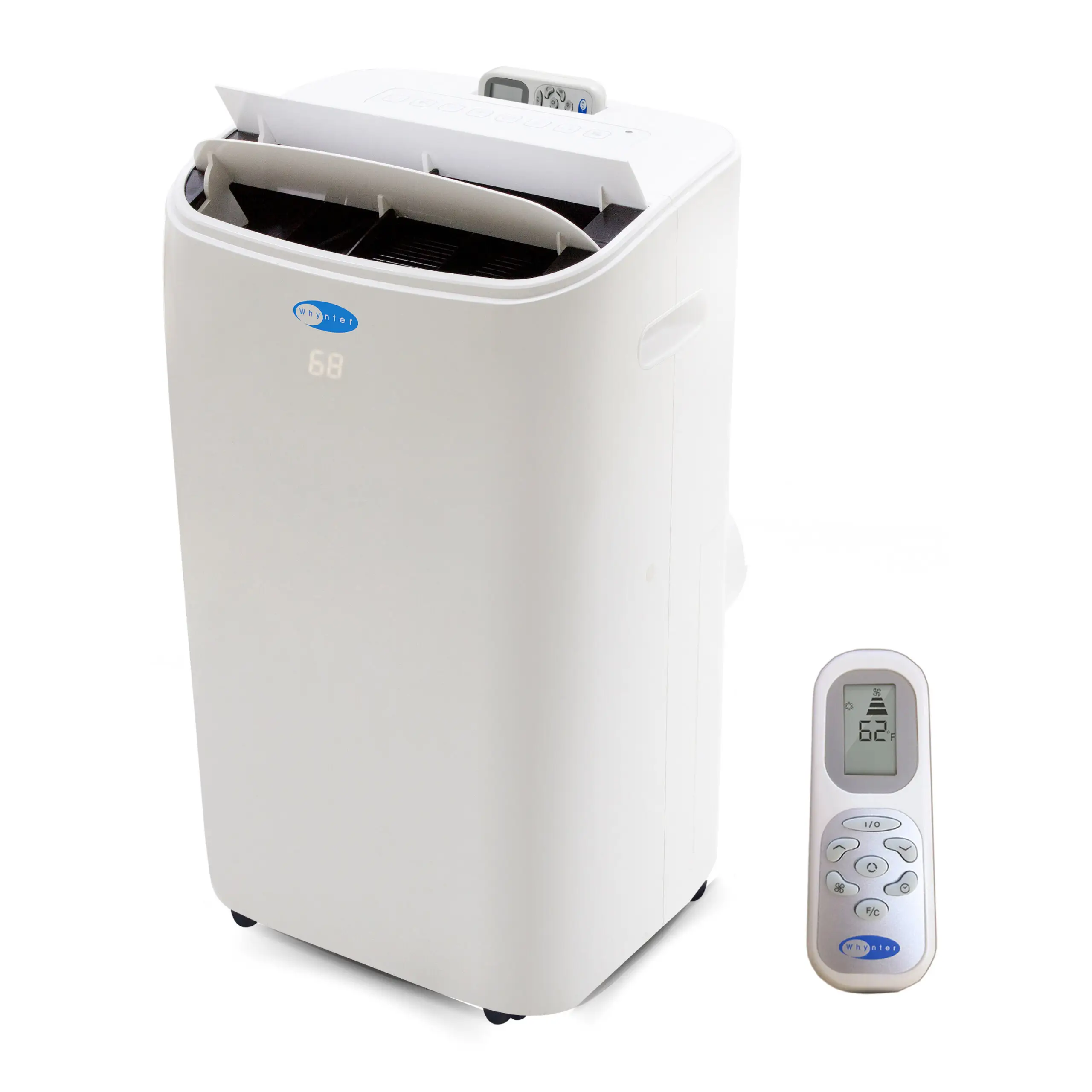
No. Both exact product pages link the same primary image; read the suffix on the actual unit and paperwork.
Explore this need in the finder →The H adds a heat pump, not extra cooling capacity
The ARC-147WFH keeps the ARC-147WF’s headline cooling tier: Whynter lists 14,000 BTU/h ASHRAE and 10,000 BTU/h SACC, along with a 500-square-foot manufacturer estimate. The H version adds an 8,200-BTU/h heating rating and a Heat mode; it does not become a 12,000-SACC cooler. If cooling is your only essential mode, ask whether paying attention to heating is worthwhile at all. If the questionnaire demands at least 12,000 SACC, neither member of this family clears that condition.
Heat is conditional on outdoor temperature and hose arrangement
The exact manual describes a heat pump and says heating will not work below 45°F ambient. That is an outdoor operating boundary, not a 45-degree room thermostat setting: the listed heating setpoint range is 61–77°F. The manual says to connect the exhaust hose in Heat mode so cold air is expelled outside. If the outdoor air is cooler than the room, it directs the user to remove the intake hose and cover that opening with the supplied panel. That seasonal setup differs from the normal dual-hose cooling arrangement, and the exhaust route still has to reach the window without a cramped, sharply bent duct.
The cooling-only WF sibling has the same SACC tier and hose system; heat should change the shortlist only when it is essential and your outdoor conditions remain at or above the 45°F manual floor. The 8,200-BTU rating is not a promise of whole-home heating.
Plan for water, but do not assume a pump route from a checkbox
Drainage documentation needs special care on this configuration. The current exact-model page marks “Pump Feature: Yes” and an upper gravity-drain port, but the model-linked manuals describe a lower manual drain, a self-evaporating system and a tank-full shutoff; they do not explain a pump hose or a continuous heat-mode drain connection. The 2023 manual says that above 70% humidity the evaporative system can leave some water in the tank, and its troubleshooting section says a full reservoir stops the unit. The 2021 manual linked directly from the current page similarly emphasizes the manual drain port and tank-full indicator. Because those versions do not give the same actionable pump instructions as the current page’s isolated checkbox, a built-in pump route or a “heat without monitoring” plan is not a safe essential match. Keep a drain point accessible and verify the exact manual and supplied drain parts for the unit you are offered.
This qualification changes the finder answer: the model can meet an ordinary “heat is essential” choice because Heat mode is documented, but it cannot confirm either “I require a hose and can route it” or “heating must work without a drain hose” from the conflicting pump/drain evidence. If an exact drain method is non-negotiable, the ARC-1050XPH offers a clearer manufacturer manual route, but it is a single-hose 10,000-SACC unit whose separate manual calls for its supplied hose during Heat mode. The older ARC-1230WNH is a higher SACC dual-hose alternative with a documented heat-drain line, subject to the same need to check its exact offered version.
Good window fit matters as much as its dual-hose label
The product page and manual list two 5.9-inch intake/exhaust hoses, a 20-to-46-inch slider, three fan speeds, auto-swing louvers, a remote, a 24-hour timer, and HEPA plus activated-carbon filters. Whynter says the supplied hose can extend up to 59 inches but cautions against an exhaust run longer than nine feet. The rated power supply is 115 V / 60 Hz, with a maximum listed 1,341 W / 11.8 A. Use a grounded receptacle and follow the manual’s no-extension-cord warning. Measure the window opening, the distance to the wall and room for the louver before choosing the cabinet position.
The washable pre-filter should be cleaned about every two weeks depending on use. The HEPA and carbon elements are not washable; the manual treats them as optional replacements.
Do not use conflicting weight or label data as hard limits
The current page gives 17.74 by 30.87 by 15.81 inches and 77 pounds. Whynter’s 2023 manual agrees with those dimensions but gives 83.7 pounds; the older 2021 manual linked on the current product page instead prints 17.75 by 16 by 31 inches and 87.25 pounds. The near-equal dimension figures are not an adequate certificate for a tight cabinet, and the weight gap is large enough to matter on stairs. The exact matched dimension and weight fields therefore remain unknown. Get the exact suffix and check the unit or carton before relying on a narrow clearance or solo-lift limit.
The page and manuals show 7.83 CEER, and the page gives below-51/54-dBA low/high claims; the newer manual lists the same split while the older manual gives a single below-54-dBA value. No independent energy or noise measurements are available here. Whynter’s legacy page links an exact ARC-147WFH EnergyGuide, but that file returns 404. Therefore label CEER, annual label energy use and cost remain unknown despite the page/manual CEER.
Who should select the H over the WF?
Choose this configuration for a room that can use 10,000-SACC cooling and occasional heat above the manual’s 45°F ambient floor, provided the venting, tank checks and exact water route work for you. Choose the plain ARC-147WF if you only need cooling and want no reason to pay for an unused heater. If the system must heat below 45°F, avoid treating this as a solution. If you need a proven continuous pump drain, precise body measurements, an app promise, or label-based efficiency proof, resolve that exact requirement first. The current product page calls the model Wi-Fi in its title/metadata, but the feature list and manual do not document an app setup path; connected control is not treated as verified. This review is based on manufacturer documentation, not hands-on testing.
Key details at a glance
| DOE seasonal-adjusted cooling capacity | 10000 BTU/h |
|---|---|
| Manufacturer's stated room area | 500 sq ft (stated, not a guarantee) |
| Documented modes | cool / dehumidify / heat / fan |
| Dual-hose exhaust arrangement | Yes |
| Listed limited warranty | 1 years |
| Window-kit minimum width (where exact manual confirms) | 20 in |
| Window-kit maximum width (where exact manual confirms) | 46 in |
| Minimum whole-degree ambient for heat-pump operation | 45 °F (manual) |
| Supplemental heat documented | Yes |
Use the exact model’s instructions for operating limits, supplied equipment and version differences.
Sources for this assessment
- Whynter exact ARC-147WFH current U.S. product page
- Whynter exact ARC-147WFH legacy product page
- ARC-147WFH operating manual linked from the current exact-model page
- ARC-147WFH manual linked from the Whynter legacy exact-model page
- Exact ARC-147WFH EnergyGuide linked from the legacy page; direct request returned 404
- Primary image linked from both exact ARC-147WF and ARC-147WFH product pages

Keep the model number in the decision.
Check the listed suffix, included vent kit, room conditions and service instructions before ordering.