
Your needs, this model
Does it fit your priorities?
Can the ARC-147WF meet a 10,000-BTU/h SACC cooling minimum?
Yes. Whynter's exact page and manual both list 10,000 BTU/h SACC. A 12,000-SACC requirement is not met by its 14,000-BTU/h ASHRAE headline.
Explore this need in the finder →Can this configuration provide heat when heating is essential?
No. The ARC-147WF page lists Heat Mode: No; ARC-147WFH is a separate heat-pump variant.
Explore this need in the finder →Does it support the documented dual-hose setup?
Yes. The exact page and manual identify separate intake and exhaust hoses; the window kit still has to fit.
Explore this need in the finder →Can it satisfy an essential app-control requirement?
Not confirmed. Wi-Fi appears in the exact product-page title and metadata, but the model's detailed feature list and linked manual do not describe app setup or remote integration.
Explore this need in the finder →Can a page/manual CEER of 7.83 satisfy an exact EnergyGuide threshold?
Not confirmed. The legacy product page's ARC-147WF EnergyGuide link returned 404, so label CEER is unknown.
Explore this need in the finder →Are the exact matched cabinet dimensions and net weight established for a tight fit or lifting limit?
No. Page/manual dimensions differ slightly, and the listed net weights differ by more than 10 lb; neither matched value is used for a hard fit.
Explore this need in the finder →The WF is a 10,000-SACC cooler, not a heater
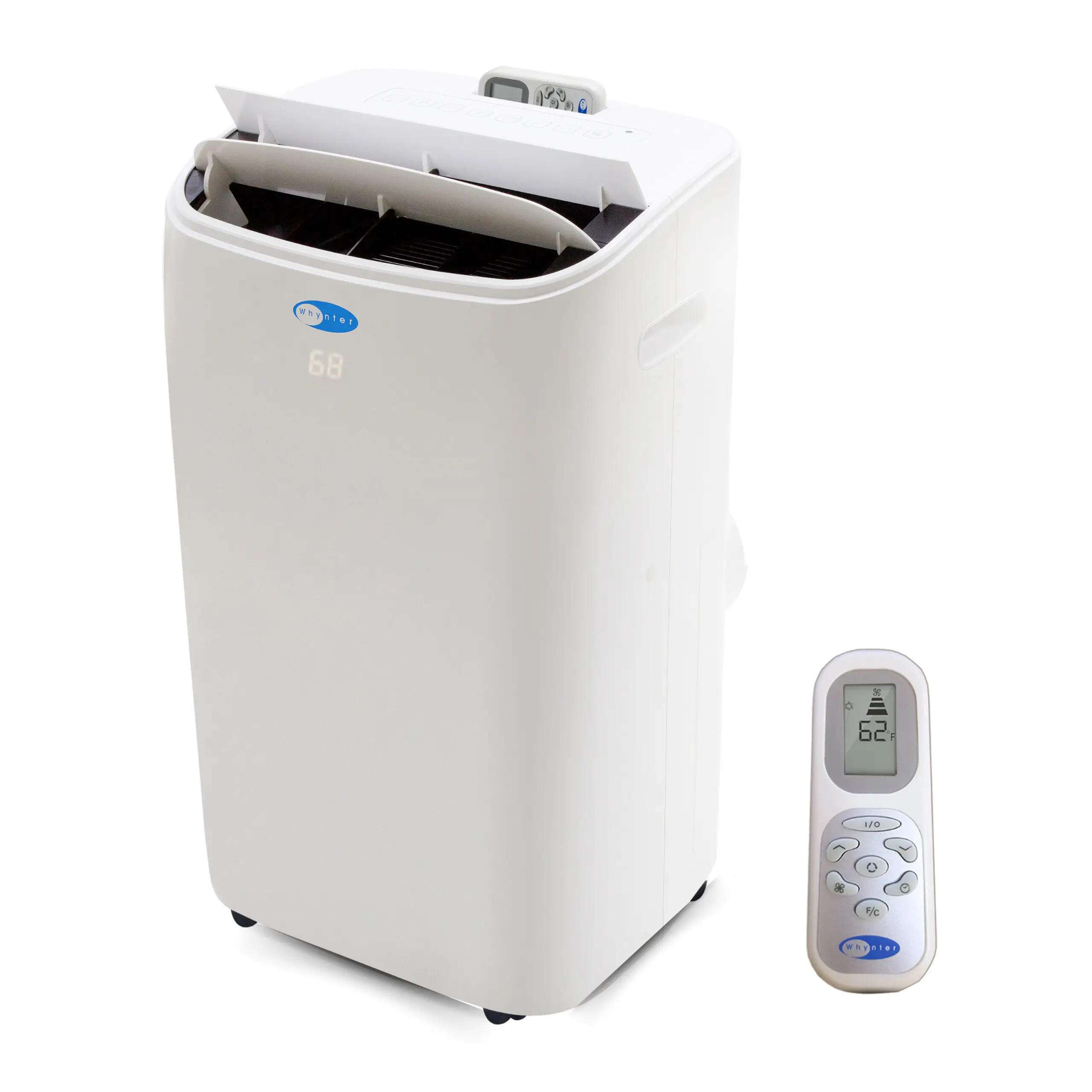
The Whynter ARC-147WF is the cooling-only member of a closely related pair. Whynter lists 14,000 BTU/h by the ASHRAE rating and 10,000 BTU/h SACC for the WF, and gives a 500-square-foot room figure. Those are not two competing estimates of the same test: use the SACC number when comparing portable AC capacity in this guide. If your questionnaire choice is a 10,000-BTU/h minimum, the ARC-147WF meets that documented threshold; if you require 12,000 SACC, it does not. The larger ASHRAE headline is not a substitute for that missing 2,000 SACC.
A dual-hose plan needs a window route and room around the cabinet
The exact product page and the WF manual describe a two-hose configuration: one intake and one exhaust hose, each 5.9 inches in diameter. That is a meaningful choice if you require dual-hose operation, but it is not an installation-free appliance. The kit is specified for a 20-to-46-inch window opening; check the clear track opening rather than the outer window frame. Keep the hose run short and avoid tight bends. Whynter says not to extend the exhaust duct beyond nine feet, even though the page gives an extendable hose length up to 59 inches. Those numbers describe different things: the supplied hose length and the manufacturer’s ceiling on an extended run.
The unit is rated for 115 V / 60 Hz and its maximum input is listed as 1,341 W / 11.8 A. The manual calls for a properly grounded outlet and cautions against extension cords or sharing the outlet with other appliances. It also recommends substantial clearance around the cabinet and louver; plan the outlet, hose path and furniture clearance before wheeling it into a narrow corner.
HEPA and carbon filters add upkeep, not a room-size guarantee
Cooling, Dry and Fan are the three listed modes; there is no Heat mode on the ARC-147WF. This is the key answer if the questionnaire makes heating essential: the WF must be ruled out, even though its ARC-147WFH sibling looks very similar and shares the same cooling rating. The WF has a remote, three fan speeds, swing louvers and a 24-hour timer. Whynter’s current page title and metadata call it Wi-Fi, but the model’s feature list and linked operating manual do not explain an app, pairing, or connected-control setup. Treat app support as unconfirmed rather than selecting the WF to satisfy an essential app requirement.
The manufacturer lists HEPA and activated-carbon filters. The manual says the washable pre-filter should be cleaned at least about every two weeks, depending on use, while the carbon and HEPA elements are not washable and are optional replacements. These filters do not turn the machine into a room air cleaner with an independently established performance claim. For ordinary cooling, Whynter describes self-evaporating condensate as automatic in most conditions; the manual also says that above 70% humidity some water remains in the tank, and a full tank stops operation until it is drained. Keep the lower drain accessible and do not treat “self-evaporating” as “never check for water.”
Several attractive numbers are not safe fit or energy filters
Whynter’s page gives a 17.74-by-30.87-by-15.81-inch cabinet and a 73.83-pound net weight. The exact WF manual instead prints 17.75 by 16 by 31 inches and 84 pounds. The cabinet figures are close but not identical, and the weight difference is more consequential for stairs or lifting. Accordingly, the exact matched cabinet dimensions and weight are not treated as confirmed here; check the actual unit and packaging before a tight alcove or lifting decision. Likewise, the page claims below 51 dBA on low and below 54 on high, while its linked manual gives only an overall below-54-dBA figure. These are manufacturer claims, not measurements made in a home or lab.
The exact current page and manual both give a 7.83 CEER figure, but Whynter’s legacy product page links an ARC-147WF EnergyGuide PDF that now returns 404. Since the shortlist’s efficiency filter is based on the exact yellow label, the verified label CEER remains unknown. If the questionnaire makes a minimum EnergyGuide CEER essential, this model will not pass on the strength of a webpage or manual number alone. Whynter lists a one-year limited warranty plus an additional two years for the compressor; that is not a promise that all parts receive three years of coverage.
Who should compare the WF with its heat-capable twin?
The ARC-147WF makes sense when 10,000 SACC is enough, a dual-hose window setup is practical, and cooling is the only essential compressor mode. Choose the ARC-147WFH only if heating matters and its outdoor-temperature and water-management limits also fit your plan. The H suffix adds a heat pump; it does not raise the 10,000-SACC cooling rating. If you need 12,000 SACC and can accept a different cooling-only layout, compare the dual-hose ARC-1230WN. If you need a verified app, an exact EnergyGuide efficiency threshold, or dimensions accurate to a tight space, keep those conditions open until the exact configuration is confirmed rather than guessing from a shared white cabinet.
This is a document-based assessment, not a hands-on cooling, sound, energy or durability test. The product page’s Wi-Fi wording, manual’s controls, and exact current configuration should be reconciled with the seller before connected control is treated as essential.
Key details at a glance
| DOE seasonal-adjusted cooling capacity | 10000 BTU/h |
|---|---|
| Manufacturer's stated room area | 500 sq ft (stated, not a guarantee) |
| Documented modes | cool / dehumidify / fan |
| Dual-hose exhaust arrangement | Yes |
| Listed limited warranty | 1 years |
| Window-kit minimum width (where exact manual confirms) | 20 in |
| Window-kit maximum width (where exact manual confirms) | 46 in |
| Built-in condensate pump | No |
| Supplemental heat documented | No |
Use the exact model’s instructions for operating limits, supplied equipment and version differences.
Sources for this assessment
- Whynter exact ARC-147WF current U.S. product page
- Whynter exact ARC-147WF legacy product page
- ARC-147WF manual linked from the current exact-model page
- Exact ARC-147WF EnergyGuide linked from the legacy page; direct request returned 404
- Primary image linked from both exact ARC-147WF and ARC-147WFH product pages

Keep the model number in the decision.
Check the listed suffix, included vent kit, room conditions and service instructions before ordering.