
Your needs, this model
Does it fit your priorities?
Can this model satisfy an essential 5,000-BTU/h SACC minimum from unconflicted exact evidence?
No. Exact manufacturer sources conflict between 6,345 and 6,500 BTU/h SACC, and the manual does not resolve the rating. Unknown/conflicting capacity is not treated as meeting a minimum.
Explore this need in the finder →Does the installation use separate exhaust and condenser-intake hoses?
Yes. The exact model page and manual document a dual-hose configuration.
Explore this need in the finder →Can it meet an essential heating requirement?
No. The exact page and manual identify cooling-only operation and Heat Mode: No.
Explore this need in the finder →Gray dual-hose cooling, with an unsettled DOE capacity
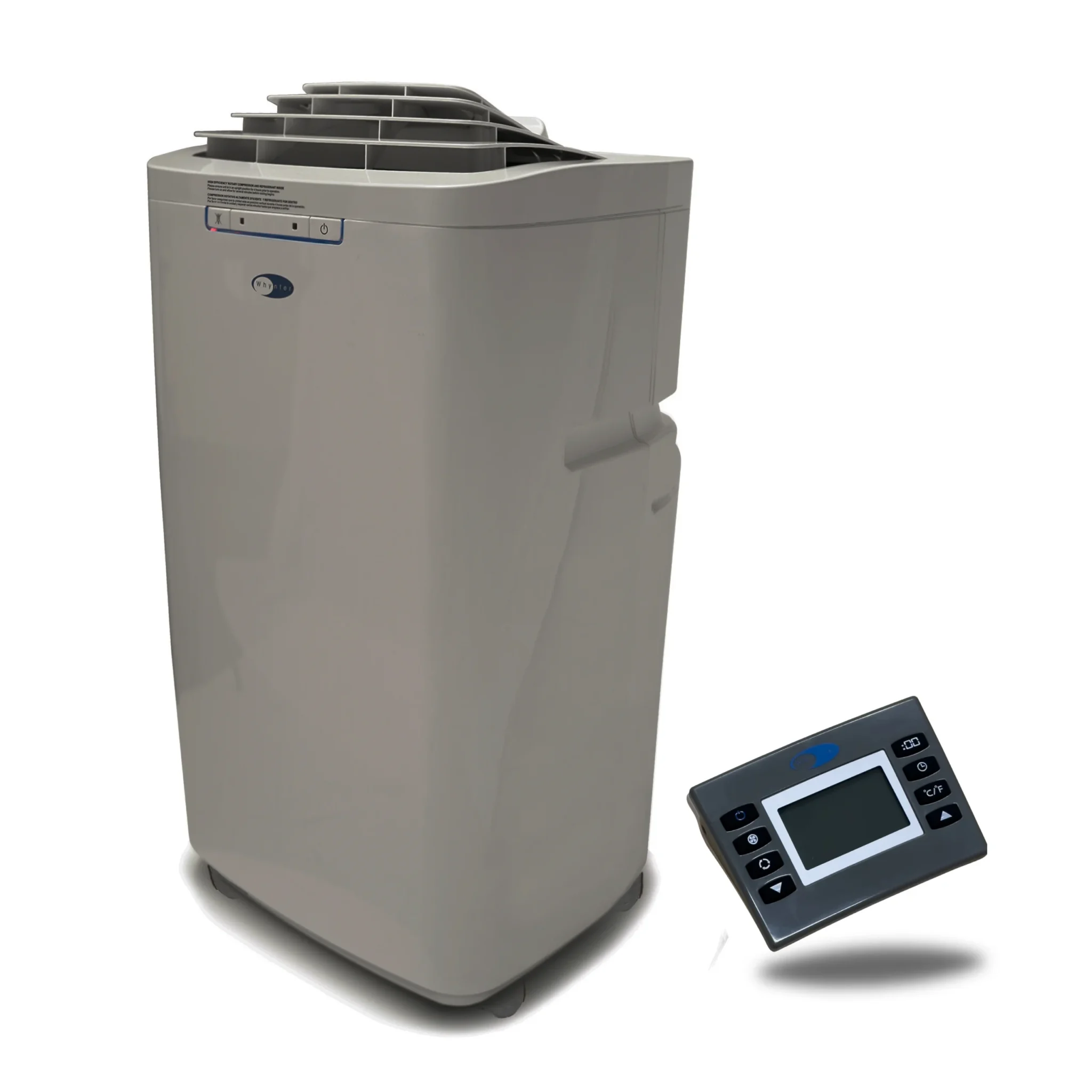
The Whynter ARC-131GD is a gray, dual-hose portable air conditioner with no heat mode. Its exact product page lists 13,000 BTU/h ASHRAE cooling and suggests rooms up to 420 square feet. However, its DOE capacity cannot be safely reduced to one number: the page summary says 6,345 BTU/h SACC, the page’s specification table says 6,500, and the linked manual’s technical table lists 13,000 BTU cooling without giving SACC. The archived older official product page shows yet another presentation of 6,345.87. Since those differences affect a hard capacity threshold, I leave the SACC unknown for matching rather than choosing a convenient value.
That uncertainty does not mean a shopper should ignore capacity. It means the ARC-131GD cannot honestly be selected by a required DOE minimum until the exact documentation is reconciled. The area figure is also a manufacturer estimate, not a result measured in a particular home. Sun, air leakage, room shape, insulation and internal heat remain relevant.
Dual hoses, compact listed height and a broad window span
The cabinet uses a large exhaust and smaller intake hose, with an included window slider listed for 20–46 inches. The manual allows trimming the slider shorter only without cutting through the hose openings and says a wider window needs additional material or another slider. It also advises keeping the exhaust path as short and straight as possible, with no more than nine feet total extension. Leave the specified airflow clearance around the cabinet; a window panel measurement alone is not a complete fit check.
Both the page and manual list dimensions of 17.3 by 15.4 by 30.5 inches. Weight conflicts: the page gives 68 pounds and the manual lists 67. The page says the gray finish, four fan speeds and up to 420 square feet, but none of those details resolves the SACC issue. Casters allow rolling on an appropriate level surface, but the manual warns to transport the appliance upright and take care not to tip it beyond its stated limit.
Drainage, filter and controls
The page and manual say the ARC-131GD is self-evaporating in most conditions; the manual says it can still collect water in the reservoir in high humidity. It has a lower manual drain and an upper gravity-drain port for continuous drainage. No pump feature is listed. Plan a safe drain route if the room is humid or if you want continuous drainage, and do not confuse the unit’s evaporation claim with a lift pump.
Four modes—auto, cool, dry and fan—are listed, along with four fan speeds, remote and onboard controls, timer, automatic restart and a washable pre-filter. The manufacturer recommends cleaning the pre-filter about every two weeks and replacing the activated-carbon filter every two to three months or as needed. The manual says dry the washable filter fully before returning it to the unit. Whynter’s temperature range for cooling is 61–89°F; no heating operation is specified.
The efficiency figures do not form one comparable label
The model-named EnergyGuide shows estimated annual use of 3,030 kWh and an estimated cost of $364. It does not display CEER in the extracted label. The manual reports CEER 5.88 and EER 8.42, but that manual CEER is not substituted for the exact EnergyGuide value requested by the site’s efficiency filter. A missing label field is unknown, not a failing efficiency result; a user who makes CEER essential will not get this model as a verified match. The label estimate is not a household bill and actual consumption depends on operating hours, climate, thermostat setting, electricity rates and building heat gain.
Maximum-power reporting also differs: the page gives 1,050 watts/9.5 amps, while the manual technical page lists 1,180 watts/10.8 amps. Weight differs by one pound. The manufacturer’s noise claims are below 52.5 dBA on low and below 56 on high; they are not our measured sound levels. The page lists one year of limited warranty and three years on the compressor.
When this model is a sensible comparison
The ARC-131GD can be considered when gray finish, dual hoses, cooling-only operation and its documented installation plan suit the room, and the exact capacity uncertainty is not a hard buying condition. If you need a confirmed SACC minimum, use a model with matching page/manual evidence such as Whynter ARC-110WD at 5,900 SACC, or ARC-12SD at 6,936 SACC, though both have their own size and use tradeoffs. For a heater, this is the wrong suffix; ARC-12SDH or ARC-122DHP are separate heat-capable configurations, not variants with interchangeable facts.
The current exact product page, model manual and page-linked EnergyGuide were reviewed; the legacy official page was also checked because the current SACC fields disagree. This is a source-based assessment, not a hands-on trial or an owner review. No actual cooling, sound, durability, price or stock claim is made.
Key details at a glance
| Manufacturer's stated room area | 420 sq ft (stated, not a guarantee) |
|---|---|
| Documented modes | auto / cool / dehumidify / fan |
| Dual-hose exhaust arrangement | Yes |
| Manufacturer's lowest sound claim | 52.5 dBA (claim, not our measurement) |
| Cabinet width | 17.3 in |
| Cabinet height | 30.5 in |
| Cabinet depth | 15.4 in |
| Listed limited warranty | 1 years |
| Window-kit minimum width (where exact manual confirms) | 20 in |
| Window-kit maximum width (where exact manual confirms) | 46 in |
| Built-in condensate pump | No |
| Supplemental heat documented | No |
Use the exact model’s instructions for operating limits, supplied equipment and version differences.
Sources for this assessment
Keep the model number in the decision.
Check the listed suffix, included vent kit, room conditions and service instructions before ordering.