
Your needs, this model
Does it fit your priorities?
Does the ARC-12SD meet a 6,000-BTU/h DOE cooling threshold?
Yes. Whynter’s exact page lists 6,936 BTU/h SACC, clearing 6,000 but not 7,100.
Explore this need in the finder →Does the installation have a separate intake and exhaust hose?
Yes. The exact specification and model manual describe a dual-hose installation.
Explore this need in the finder →Can it meet an essential need for heating in the same appliance?
No. Its exact product page says Heat Mode: No, and the manual lists cooling, fan and dehumidifying operation.
Explore this need in the finder →The cooling-only dual-hose middle ground
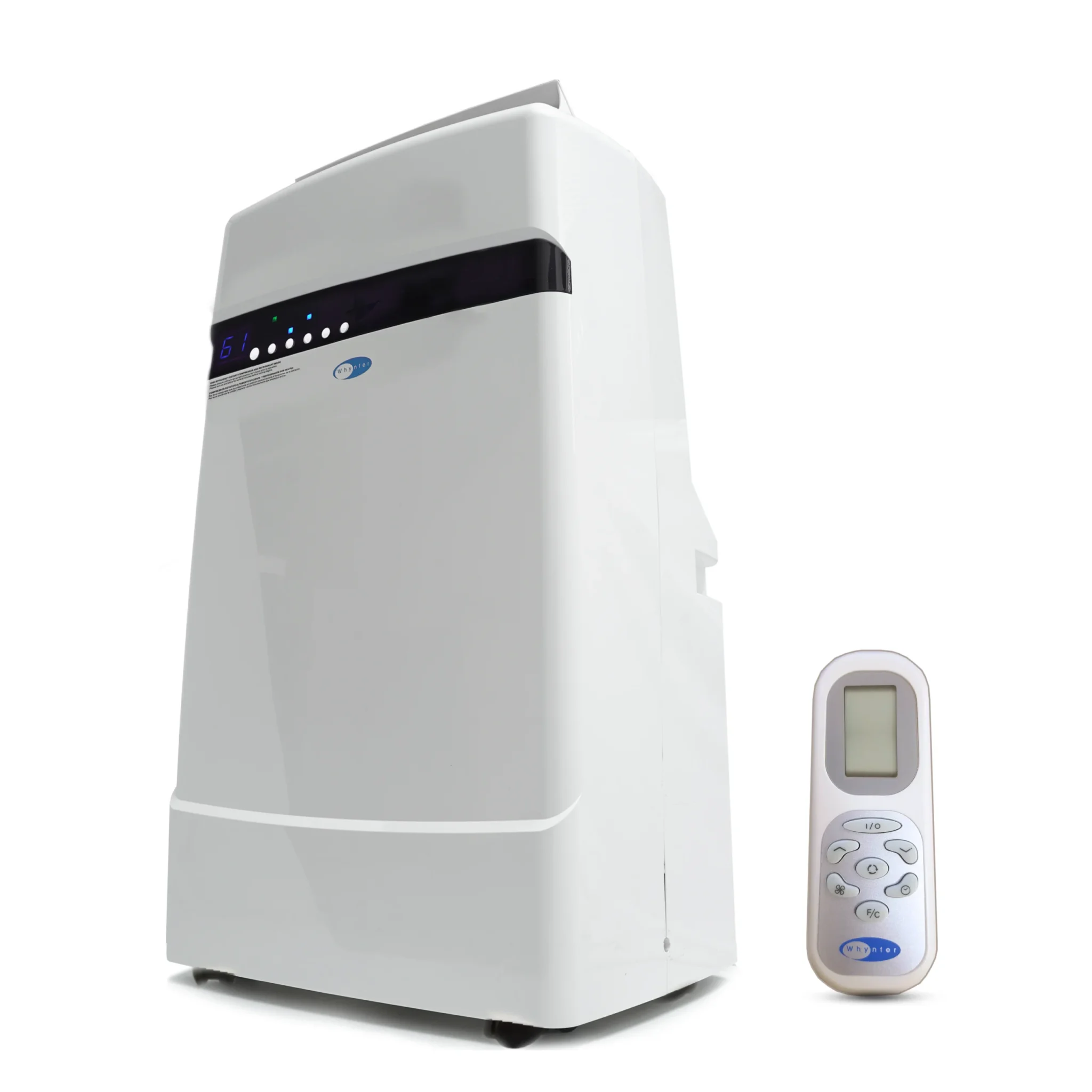
Whynter’s ARC-12SD is a white portable air conditioner rated at 12,000 BTU/h ASHRAE and 6,936 BTU/h SACC on its exact product page. It uses a dual-hose layout, so the cooling setup has separate outside-air intake and hot-air exhaust paths. The page suggests a room up to 400 square feet; treat that figure as a starting estimate only. Sun, insulation, ceiling height, open doors and equipment heat all affect whether a portable unit can hold a comfortable setpoint.
Although the ARC-12SD and ARC-12SDH share much of their naming and cabinet dimensions, the ARC-12SD is cooling-only. The exact product page says Heat Mode: No, and its manual lists cooling, dehumidifying and fan operation. It is not the model to buy for shoulder-season heat. The heating suffix belongs to ARC-12SDH, which has its own specifications and a heat-capacity disagreement between its product page and manual.
Check hose clearance as well as cabinet dimensions
The included window slider is listed for 20–46 inches. The manual allows cutting the slider to fit a smaller opening, but warns against cutting through its hose cutouts; for a wider span, another panel solution is needed. The cabinet is listed at 20 inches wide, 16.5 inches deep and 34 inches high. That is a sizable footprint for a portable appliance, and the two-hose connections need room behind it. Whynter advises 20 inches of airflow clearance and keeping the hoses as short and straight as possible, with no more than nine feet of extension.
Its listed weight is not consistent: the page gives 78 pounds, while the manual technical table gives 71. Casters can help with moving it on a level floor, but do not make it a light appliance for stairs. For a strict carrying threshold, do not assume either number is the definitive net weight; confirm the label on the exact unit.
Water management still belongs in the setup plan
Whynter describes automatic evaporation in most environments and lists a dehumidification capacity of 96 pints a day. The ARC-12SD has a lower port for manual draining and an upper port for continuous gravity drainage. The manual’s exact drain procedure calls for a separately purchased hose for continuous drainage; the product page says the built-in pump feature is No. Self-evaporating does not mean water can never collect, particularly in humid conditions. If you use the optional gravity route, plan a downward path to a suitable drain and check it for secure connections.
The manual’s filter instructions call for cleaning the washable pre-filter at least every two weeks depending on use. The activated-carbon filter is intended for odors and is replaced rather than washed. Whynter says to drain collected condensation, clean filters before seasonal storage and move the cabinet upright. The model includes digital and remote controls, three fan speeds, a timer and automatic restart; a connected app is not documented.
Do not overstate the efficiency label
The manual reports CEER 6.66 and EER 9.86, but the product page’s linked yellow EnergyGuide is mislabeled: the sheet names ARC-14SH rather than ARC-12SD. I therefore do not use its label values as ARC-12SD efficiency or annual-cost data, and I leave the CEER field unknown for a hard efficiency filter. This is not evidence that the unit is inefficient or efficient; it is a product-document mismatch. The manual figures remain useful as manual-reported values but are not swapped into a label-based comparison.
Whynter’s page-listed low/high noise claims are below 51.5 and 56 dBA. They are manufacturer specifications rather than independent readings. The listed limited warranty is one year, plus three years on the compressor; that longer compressor term does not mean three years of full-unit coverage.
When the ARC-12SD is the right version
This model is a fit when you want dual-hose cooling, the documented page SACC of 6,936 BTU/h meets the room’s need, a 20–46-inch slider works and you can accommodate a 34-inch cabinet with drainage access. Choose ARC-12S instead if a lower 31-inch cabinet and single hose are more useful and 5,000 BTU/h SACC is sufficient. Choose ARC-12SDH only if heat matters; its page SACC is close at 6,884, but its heating-capacity and weight figures conflict with the manual. For a dual-hose heater with a more explicit pump-assisted drain routine, compare the separate ARC-122DHP, whose documented SACC is 7,000 BTU/h and whose heat operation has an ambient-temperature limit.
Sources checked: the exact ARC-12SD page, model manual and the page-linked EnergyGuide. This is documentation analysis, not a hands-on test, and makes no owner-experience, measured-noise, durability, current price or stock claim.
Key details at a glance
| DOE seasonal-adjusted cooling capacity | 6936 BTU/h |
|---|---|
| Manufacturer's stated room area | 400 sq ft (stated, not a guarantee) |
| Documented modes | cool / dehumidify / fan |
| Dual-hose exhaust arrangement | Yes |
| Manufacturer's lowest sound claim | 51.5 dBA (claim, not our measurement) |
| Cabinet width | 20 in |
| Cabinet height | 34 in |
| Cabinet depth | 16.5 in |
| Listed limited warranty | 1 years |
| Window-kit minimum width (where exact manual confirms) | 20 in |
| Window-kit maximum width (where exact manual confirms) | 46 in |
| Built-in condensate pump | No |
| Supplemental heat documented | No |
Use the exact model’s instructions for operating limits, supplied equipment and version differences.
Sources for this assessment
Keep the model number in the decision.
Check the listed suffix, included vent kit, room conditions and service instructions before ordering.