
Your needs, this model
Does it fit your priorities?
Does the ARC-1280 NEX pair meet a 10,000-BTU/h SACC cooling minimum?
Yes. The shared 2026 manual and current exact WX and MX pages identify both finishes at 10,000 BTU/h SACC. The current 13,000-BTU/h ASHRAE headline is a different test rating; the legacy page's lower 12,000-BTU/h ASHRAE figure does not change the shared 10,000-BTU/h SACC value.
Explore this need in the finder →Can either finish satisfy an essential dual-hose requirement?
Yes. Both exact current model pages and the shared manual identify the same NEX dual-hose intake/exhaust configuration.
Explore this need in the finder →Can this ARC-1280 family also provide essential heat?
No. Both exact pages say Heat Mode: No and the shared manual provides cooling, Dry, Auto and Fan operation only. Choose a documented heat-pump suffix if heating is essential.
Explore this need in the finder →Is connected App control established for both exact finishes?
Yes. The current product pages name the NetHome Plus app and the shared exact manual describes smart-app pairing; the quick-start guide documents AP pairing and schedule controls. It is a third-party app whose interface may change.
Explore this need in the finder →Will the included panel fit a measured 50-inch clear opening?
The published range is 28.7–82 inches for both configurations, so 50 inches falls within the documented span. Measure the clear window track, not the outside frame.
Explore this need in the finder →Does the 1280 family satisfy an essential 12,000-BTU/h SACC minimum?
No. The exact shared manual and current product pages identify 10,000 BTU/h SACC, below a 12,000-BTU/h SACC requirement.
Explore this need in the finder →Can its EnergyGuide CEER meet a 12.0 minimum?
Yes. The two exact model-named EnergyGuide text extractions give CEER 12.1. The label's $70 estimated yearly cost assumes 13 cents/kWh, 8 hours of use each day and three months of seasonal use; it is not a household bill.
Explore this need in the finder →Can its listed cabinet weight meet a 55-pound maximum?
No. The shared manual lists a net unit weight of 55.34 lb, slightly above 55 lb; the product pages round this to 55 lb. A strict lifting ceiling should use the manual value, not rounded page display.
Explore this need in the finder →One NEX cooler, two exact finishes
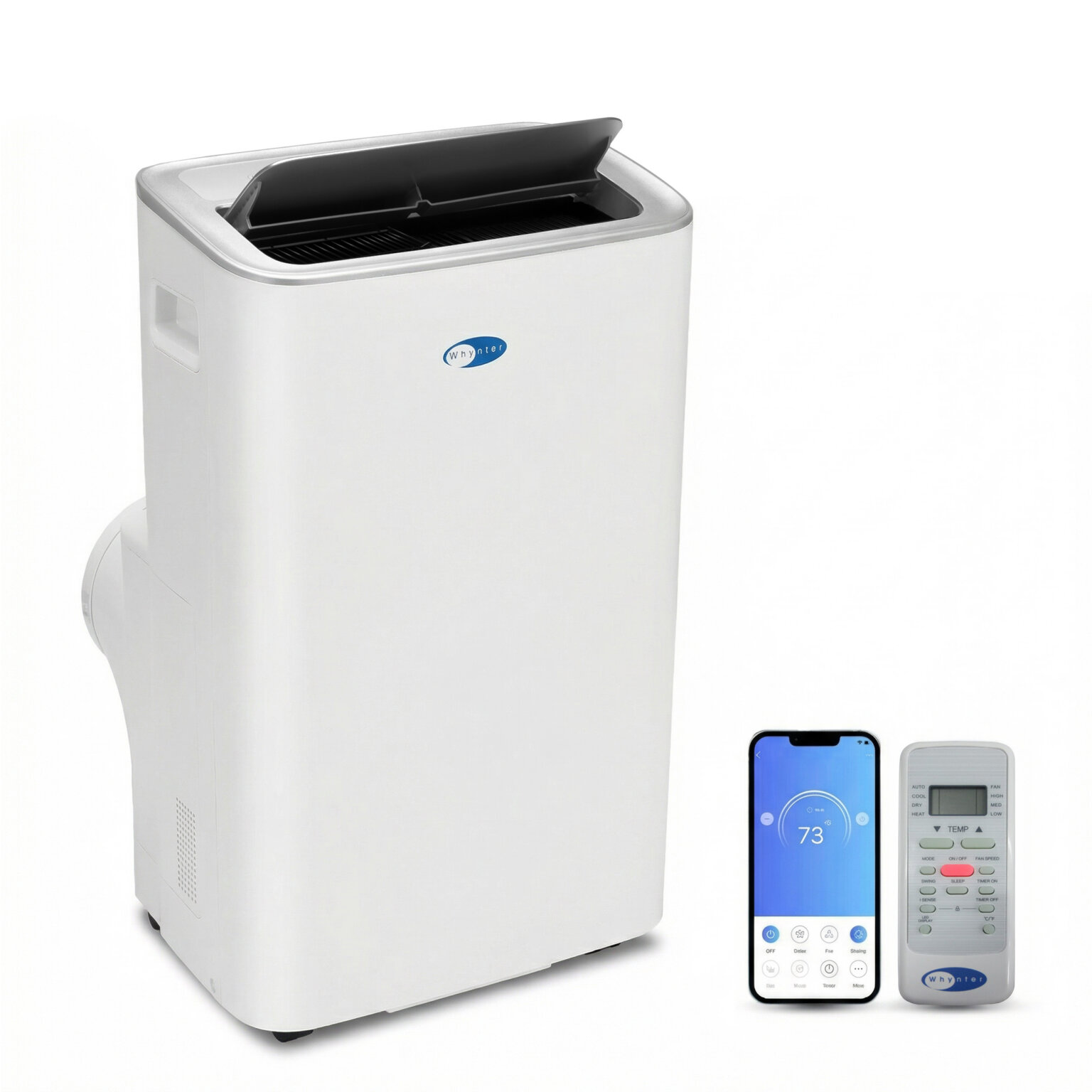
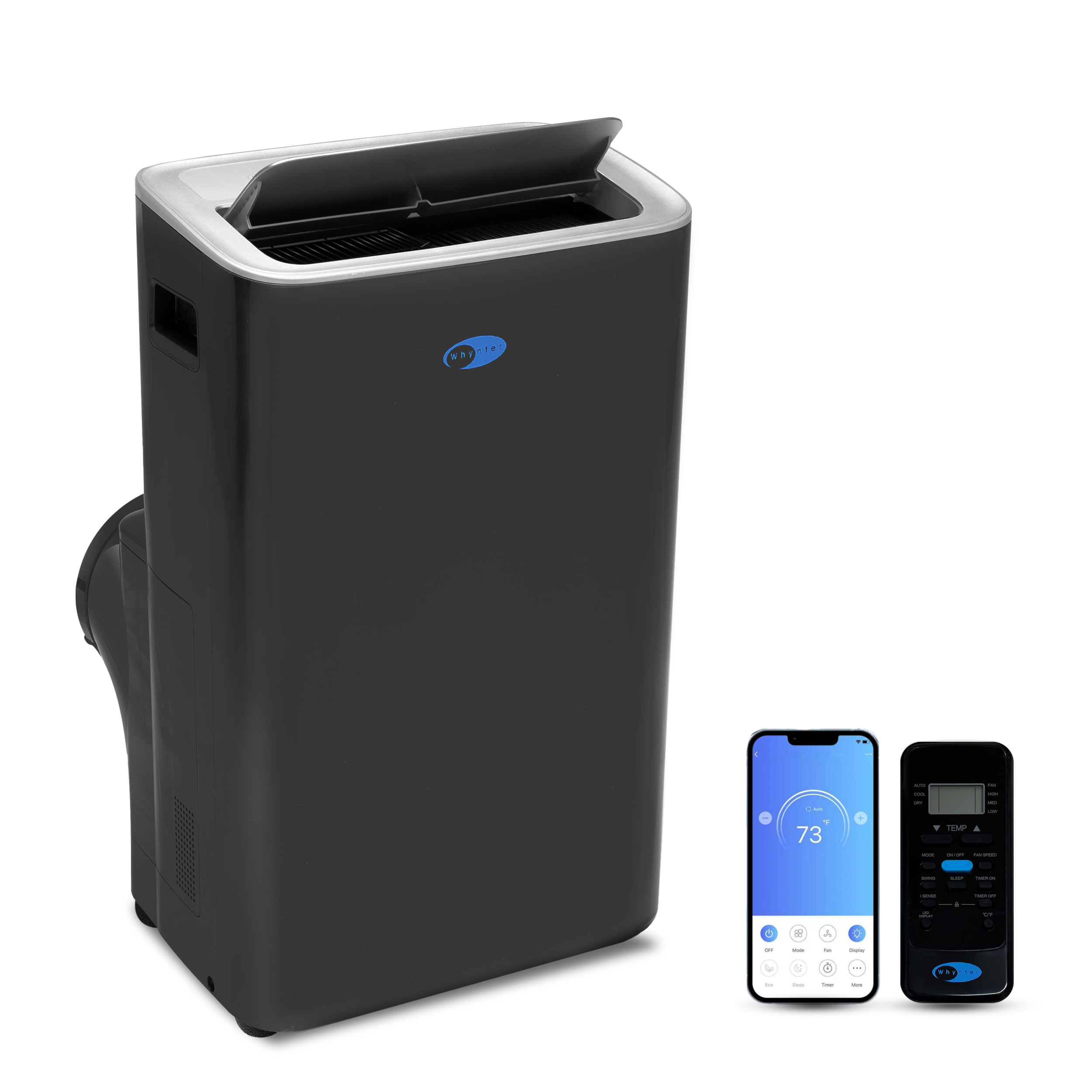
Whynter's current U.S. listings show the ARC-1280WX in white and ARC-1280MX in black. Their shared March 2026 manual names both models; both exact pages document 10,000 BTU/h SACC, two hoses, app control and matching cabinet dimensions. The practical suffix choice is finish, not cooling tier. Whynter's up-to-500-square-foot room figure is an estimate, not a promise for a sunny or open-plan room.
Mind the rating revision: current exact pages and the shared manual give 13,000 BTU/h ASHRAE / 10,000 SACC; both legacy pages say 12,000 / 10,000 and list 1,293 watts rather than the current 1,212. Use SACC for capacity comparisons. Neither finish is a 12,000-SACC unit; the ARC-1230WN is a larger-capacity alternative.
Measure a long window panel and two hose paths
This is a cooling-only dual-hose portable unit. One hose brings intake air to the machine and the other carries hot air outside; it is a more involved installation than a unit with one exhaust hose. Whynter specifies two 7.5-inch hoses, up to 60 inches long, plus a three-piece adjustable window kit. The current shared manual and quick-install sheet give a 28.7-to-82-inch opening span. Measure the clear track where the slider will actually sit. A 50-inch opening falls within that range; a narrow sash below 28.7 inches does not. The panel is not a universal seal for every window shape, and the hoses still need a short, uncrushed route to it.
The cabinet is 17.36 inches wide, 15.63 deep and 28.62 high. The manual's 55.34-pound net weight is more precise than the page's rounded 55-pound figure, so a strict 55-pound lifting cap does not fit. It draws 11.9 amps at 115 volts (maximum 1,212 watts); the manual cautions against an extension cord or shared outlet. Leave vent clearance and keep the rear hoses accessible.
Smart control is documented, but the app is third-party software
Both pages and the shared manual document NetHome Plus app control; the exact quick-start says to hold the power button for three seconds until AP appears, then pair the unit. It also covers schedules and voice-service links. Whynter lists Alexa, Google and Siri compatibility, but these third-party services may change. If app operation is essential, allow time to pair it on your network.
The unit offers Auto, Cool, Dry and Fan, a remote, swing louver, sleep mode, auto-restart and a 24-hour timer. Five fan choices are listed: continuous, auto, low, medium and high. There is no Heat mode; a separate heat-pump model must be checked for its own ambient and drainage limits.
Plan drainage and filter care before the humidest days
Whynter describes self-evaporation in normal conditions, but “self-evaporating” does not mean that the water tray can never fill. The manual says the included gravity-drain hose is required in Dry mode and recommends it for cooling in high humidity. It must run continuously downward to a suitable drain or container without kinks; gravity cannot lift condensate uphill. If the pan fills, a P1 indication stops cooling or dehumidifying until water is removed. There is no built-in lift pump. Someone needing hose-free dehumidifying should choose a different documented plan, not rely on a headline about automatic evaporation.
The manual lists two washable air filters, cleaned about every two weeks or more often in dusty homes. A separate activated-carbon filter is replaced every two to three months or as needed. Leave room to open the intake panels and remove the unit for storage. The 96.8-pint/day dehumidification rating is a manufacturer claim, not a household yield guarantee.
Read the energy and sound figures as claims, not a lab test
The model-named EnergyGuide text for both finishes gives CEER 12.1 and an estimated yearly energy cost of $70. That cost is calculated using a national-average rate of 13 cents per kilowatt-hour and eight hours a day over a three-month season; your tariff, thermostat setting, weather and operating hours change the bill. The label's cost-range figure is not a guarantee for your home. The current page and manual also list CEER 12.1, which agrees with the label reading, but this assessment does not independently measure electrical use. Whynter publishes sound figures of 50, 53 and 56 dBA by fan speed. These are manufacturer specifications, not sound readings made in an occupied bedroom.
Choose finish, or move up for capacity or heat
Choose the ARC-1280WX if you want the white cabinet, or the ARC-1280MX if black suits the room better; the maker lists separate UPCs for those exact suffixes. Both share the same current documented operating plan. They suit a window opening within the published panel range, a 10,000-SACC cooling need, and an owner willing to route two hoses and a gravity drain for Dry mode. They do not solve an essential heat requirement or a 12,000-SACC capacity minimum. For more SACC cooling, compare the dual-hose ARC-1230WN and its larger cabinet; for a similarly rated smaller NEX cabinet, inspect ARC-1030WN but check its page/manual weight and EnergyGuide conflicts. This is a manual-and-product-page assessment, not a hands-on cooling, noise, energy or durability test.
Key details at a glance
| DOE seasonal-adjusted cooling capacity | 10000 BTU/h |
|---|---|
| Manufacturer's stated room area | 500 sq ft (stated, not a guarantee) |
| Documented modes | auto / cool / dry / fan |
| Dual-hose exhaust arrangement | Yes |
| Variable-speed inverter | Yes |
| App or connected control | Yes |
| Manufacturer's lowest sound claim | 50 dBA (claim, not our measurement) |
| Combined energy efficiency ratio on EnergyGuide | 12.1 CEER |
| Cabinet width | 17.36 in |
| Cabinet height | 28.62 in |
| Cabinet depth | 15.63 in |
| Listed product weight | 55.34 lb |
| Listed limited warranty | 1 years |
| Window-kit minimum width (where exact manual confirms) | 28.7 in |
| Window-kit maximum width (where exact manual confirms) | 82 in |
| Built-in condensate pump | No |
| Supplemental heat documented | No |
Use the exact model’s instructions for operating limits, supplied equipment and version differences.
Sources for this assessment
- Whynter exact current U.S. ARC-1280MX page
- Whynter exact current U.S. ARC-1280WX page
- Whynter legacy exact ARC-1280MX page; retained as an earlier specification revision
- Whynter legacy exact ARC-1280WX page; retained as an earlier specification revision
- Shared Whynter 2026 owner manual naming ARC-1280WX white and ARC-1280MX black
- Whynter ARC-1280 Quick Installation Guide naming both finishes
- Whynter NetHome Plus App Quick Start Guide linked from the current exact product page
- Whynter ARC-1280WX EnergyGuide
- Whynter ARC-1280MX EnergyGuide
- Exact page-linked ARC-1280WX manufacturer product image
- Exact page-linked ARC-1280MX manufacturer product image


Keep the model number in the decision.
Check the listed suffix, included vent kit, room conditions and service instructions before ordering.