
Your needs, this model
Does it fit your priorities?
Does the documented 12,000-BTU/h SACC rating clear a 12,000-BTU/h cooling minimum?
Yes. The exact current product page and shared manual list 12,000 BTU/h SACC.
Explore this need in the finder →Can this exact WNH configuration heat the room?
Yes. The page and manual identify Heat mode; the sibling WN is cooling-only.
Explore this need in the finder →Can the heat-pump plan meet a 45°F minimum outdoor condition?
The exact product page says heat requires ambient conditions above 41°F, so 45°F is within its stated condition; the manual does not state a separate heat-only limit.
Explore this need in the finder →Must heating be confirmed without any drain hose?
No. The current model manual requires the included pump-drain hose in Heat mode, and the pump only runs in heating.
Explore this need in the finder →Can an exact EnergyGuide CEER minimum be confirmed for this model?
No. The current page and manual say 14.2, but the model-specific Energy Guide link on the legacy page returned 404; it cannot meet an essential label threshold here.
Explore this need in the finder →The WNH suffix adds a real heat-pump setup
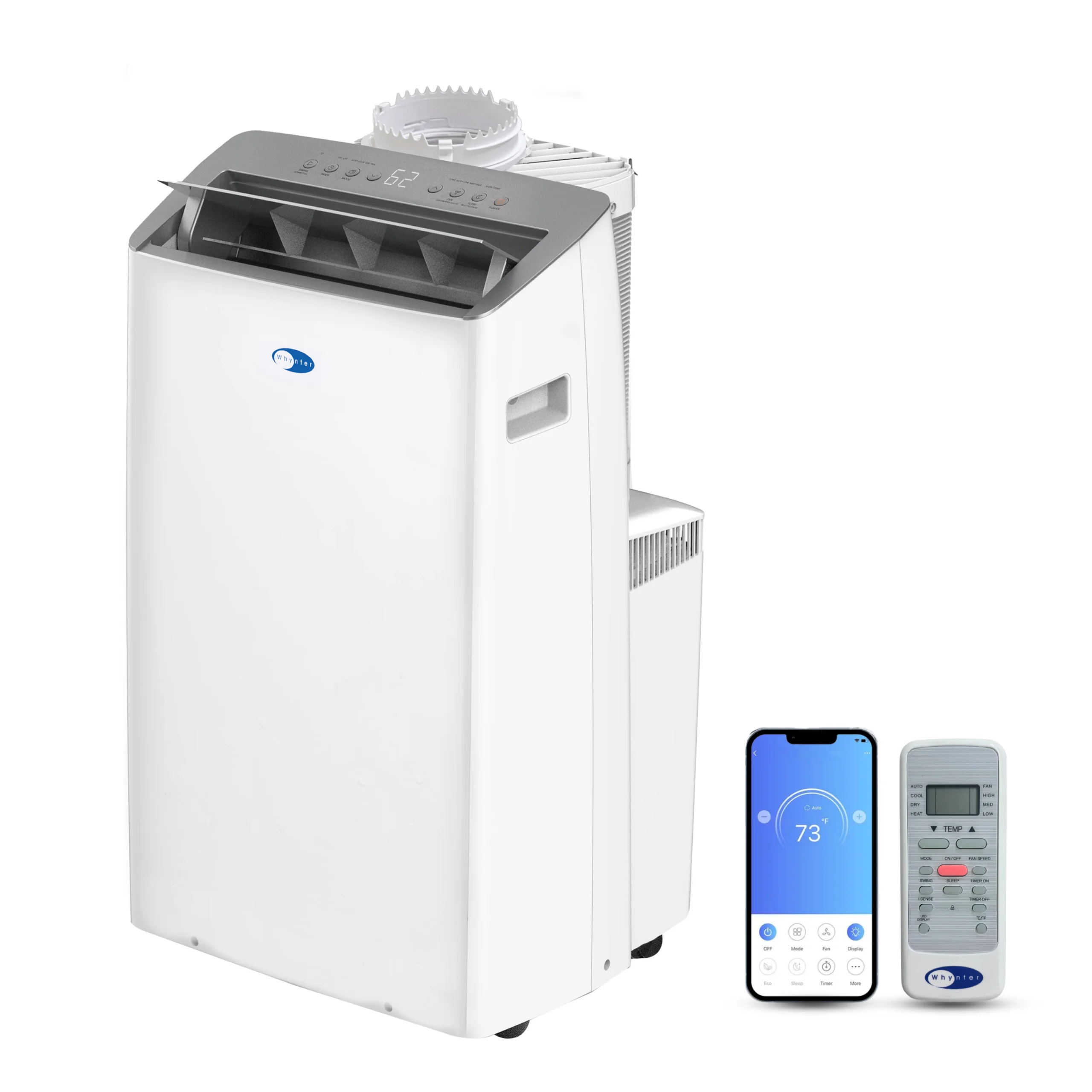
ARC-1230WNH is the heating version of Whynter's NEX inverter dual-hose family. It retains the product-page cooling rating of 14,000 BTU/h ASHRAE / 12,000 BTU/h SACC and adds a listed 12,000-BTU heating capacity. Whynter estimates up to 600 square feet, a rough guide rather than a guarantee. The shared 2026 manual separately identifies cooling-only ARC-1230WN and 10,000-SACC ARC-1030WN. The last characters matter: only WNH adds heat.
Cooling and heating use the dual hose-in-hose vent assembly. The manual says the exhaust assembly must be installed for Cool and Heat, so both modes need a secure opening to outdoors. The current product page lists a 28–82-inch window panel and a hose up to 47 inches. The kit accessory repeats 28–82 inches, but an older exact-model manufacturer page includes a 49-inch maximum in one specification row while its feature list states the longer span. The shared manual describes assembly and trimming but does not give a numeric maximum. Because of that older-source conflict, do not rely on a hard numeric fit result here; verify the slider supplied with the exact unit if the opening is near its endpoint.
Heating comes with a required drain hose
The largest ownership difference from ARC-1230WN is water routing. In Heat mode the ARC-1230WNH's condensate pump runs and the included pump-drain hose must be installed. The manual says the pump works only during heating; normal self-evaporation does not replace this heat-mode route. The hose's open end must reach a drain area. If you cannot route water safely, the heat-pump feature is not a practical choice. When cooling or dehumidifying, the family manual separately shows lower manual drainage and an upper gravity-drain hose; the integrated pump is not a general-purpose pump for every mode.
Whynter's exact model page says heating needs ambient conditions above 41°F. Its older model-specific listing gives the same boundary, while the shared manual describes a general compressor ambient operating band and does not state a distinct Heat-mode lower cutoff. The manufacturer's numbers are guidance, not a tested promise of delivered heat at a particular outdoor temperature. Treat the heat pump as supplemental room heat when your conditions fit the documented range, not as a replacement for primary heating in colder weather. The heat thermostat setting listed for the family is 60–86°F, which is a target setting inside the room—not an outdoor operating range.
It is not a smaller or lighter cabinet
The WNH shares the 19.5-inch width and 32.5-inch height of ARC-1230WN; the current page gives 16.75 inches of depth, and the manual rounds that to 16.7. Leave the manual's clearance around the hose intake and outlet and plan space for the hose curve. The listed weight is about 77.2 pounds: the exact product page says 77.25 and the manual table rounds to 77.2. This modest rounding difference does not make it a lightweight carry-upstairs appliance. Whynter's page gives a cooling power figure of 1298 W in one row and 1300 W in its feature data/manual table, at 11.9 amps and 115 volts. Use the unit's rating plate and the manual for electrical planning, and plug it into an appropriate grounded outlet.
The page and manual agree on a listed CEER of 14.2, but the current product page exposes a shared manual and app quick-start, not a retrievable model-named EnergyGuide. The legacy manufacturer's Energy Guide link was broken when checked. For a strictly label-based efficiency minimum, the exact EnergyGuide field remains unverified here; the page/manual number is shown as manufacturer documentation, not substituted for a label. There is also a low-noise inconsistency: the current page says below 42.5 dB at low speed, while its exact manual table gives 47.2 / 52.6 / 56.8 dB. Neither sound claim is a reliable predictor of an in-room result. None of these specifications is a noise or energy test performed by this review.
Filter work and day-to-day control
The machine includes a washable pre-filter and an activated-carbon layer. The manual recommends cleaning the washable filter about every two weeks during regular operation. Its maintenance section gives different intervals for the carbon filter in separate paragraphs; Whynter's model FAQ says roughly two to three months depending on use. Treat that layer as consumable and check the current instructions for the supplied filter. The page lists five operating modes—Auto, Cool, Dehumidify, Fan and Heat—plus the NetHome Plus app, Wi-Fi voice control, timer, sleep mode, filter reminder and auto restart. The NEX label and manufacturer claims do not guarantee lower bills or quieter operation in your room.
As with any portable AC, ventilation, sealing, condensate management and regular filter care matter. The manual recommends an upright settling period before first use, keeping the vent clear and draining the tray before storage. On an exceptionally humid day, cooling or Dry mode may still produce more condensate than self-evaporation removes, so do not plan around the heat pump's drain pump serving those modes.
Who should consider ARC-1230WNH?
Shortlist the WNH if you want a 12,000-BTU/h SACC dual-hose cooler, also value a heat-pump mode and can route the required drain hose while heating. Choose cooling-only ARC-1230WN if heat is not needed and you want to avoid a heat-specific drain setup. ARC-1030WN has less documented cooling capacity—10,000 BTU/h SACC—but still uses the same family-size cabinet. The WNH's extra mode does not make it easier to fit, and the room-area estimate does not replace a heat-load check. If no-drain heating, a verified EnergyGuide CEER or an exact window maximum is essential, this documentation set cannot confirm that need.
This is a source-based review, not a hands-on cooling, heating, sound, energy or durability test. Check the model label, current box contents and manual using Whynter's ARC-1230WNH product page and the shared 2026 family manual before installation.
Key details at a glance
| DOE seasonal-adjusted cooling capacity | 12000 BTU/h |
|---|---|
| Manufacturer's stated room area | 600 sq ft (stated, not a guarantee) |
| Documented modes | auto / cool / dehumidify / fan / heat |
| Dual-hose exhaust arrangement | Yes |
| Variable-speed inverter | Yes |
| App or connected control | Yes |
| Cabinet width | 19.5 in |
| Cabinet height | 32.5 in |
| Cabinet depth | 16.75 in |
| Listed product weight | 77.25 lb |
| Listed limited warranty | 1 years |
| Window-kit minimum width (where exact manual confirms) | 28 in |
| Built-in condensate pump | Yes |
| Minimum whole-degree ambient for heat-pump operation | 42 °F (manual) |
| Supplemental heat documented | Yes |
Use the exact model’s instructions for operating limits, supplied equipment and version differences.
Sources for this assessment
Keep the model number in the decision.
Check the listed suffix, included vent kit, room conditions and service instructions before ordering.