
Your needs, this model
Does it fit your priorities?
Does its documented cooling rating clear a 12,000-BTU/h SACC minimum?
Yes. The current exact product page and shared manual list 12,000 BTU/h SACC.
Explore this need in the finder →Will ARC-1230WN satisfy an essential dual-hose arrangement?
Yes. The exact page and manual call the vent design dual hose-in-hose.
Explore this need in the finder →Can a cooling-only ARC-1230WN satisfy an essential heating requirement?
No. The page says Heat Mode: No and the manual table lists no heat mode for the WN suffix.
Explore this need in the finder →Does an 8.0 minimum on the exact yellow EnergyGuide CEER pass?
Not confirmed. Page and manual list 13.8, but the current exact page does not expose the label and the legacy label URL returns 404.
Explore this need in the finder →Can a measured window span be matched against a confirmed maximum for this exact panel?
No. The current page and kit list 28–82 inches, but an older exact model page contains a 49-inch row; the maximum remains unknown to hard matching.
Explore this need in the finder →12,000 BTU/h SACC in the cooling-only NEX model
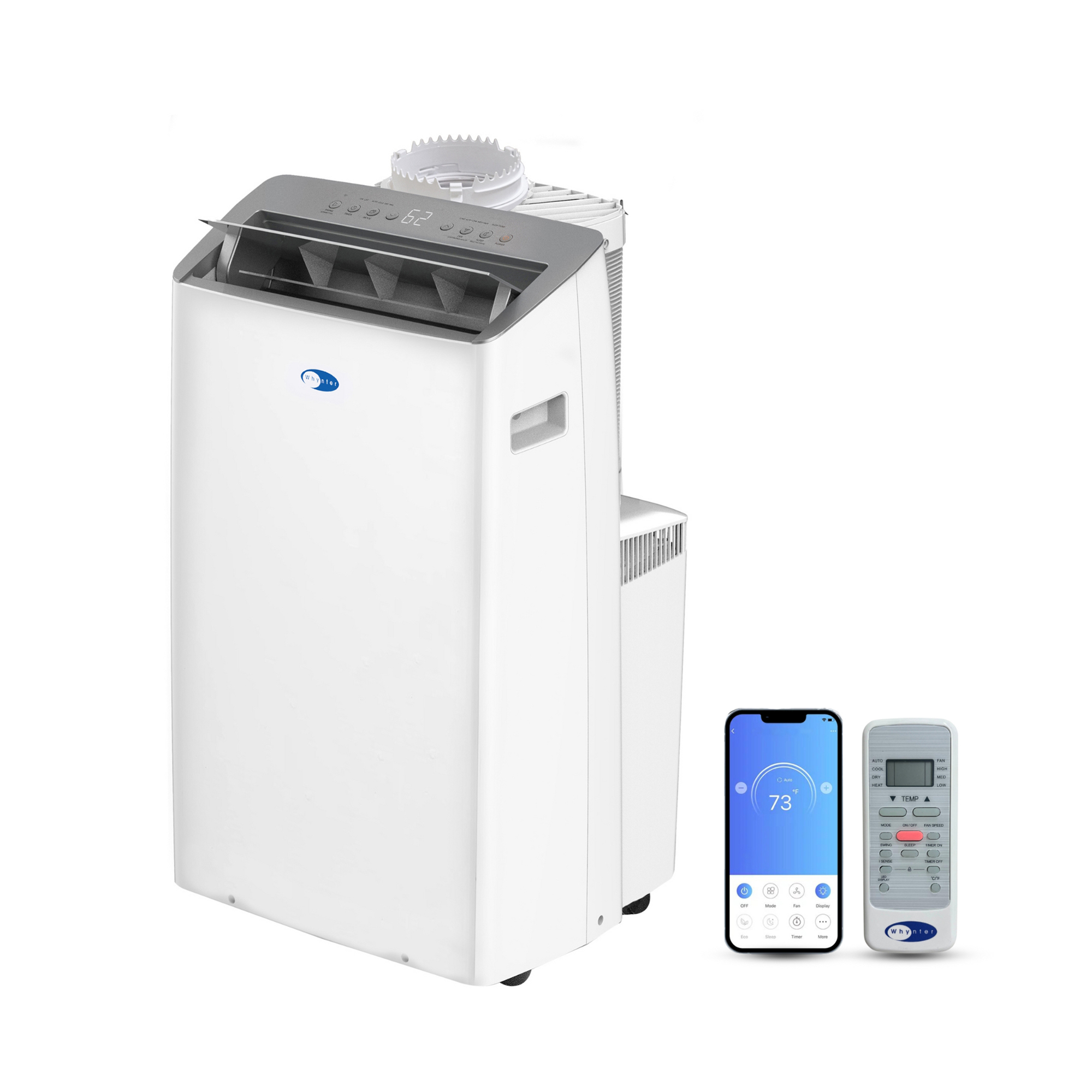
ARC-1230WN is Whynter's cooling-only 14,000-BTU/h ASHRAE / 12,000-BTU/h SACC NEX inverter portable air conditioner. SACC is the useful number for capacity comparisons; the two methods are not interchangeable. Whynter estimates coverage up to 600 square feet, but a product-page room estimate cannot account for your sunlight, ceiling, insulation, open plan or heat from electronics. The shared manufacturer manual documents ARC-1230WN and its 12,000-BTU/h SACC heat-pump sibling, ARC-1230WNH, in the same 2026 table; the WN has no heater.
Both intake and exhaust run through a dual hose-in-hose assembly. That setup brings outdoor air to the condenser rather than depending on the room for both sides of the heat-exchange path. It still needs an outdoor exhaust opening. The included three-piece window slider is listed for 28 to 82 inches on the current product page and its compatible kit, and the hose extends to 47 inches. Place the AC near the window, keep the paired hose short and straight, and preserve the manual's 20-inch clearance around the ends. A long route, tight bend or crushed hose is not solved by the high BTU headline.
Same large cabinet as the heat-pump version
The published cabinet dimensions are 19.5 inches wide by 16.75 deep by 32.5 high; the shared manual rounds depth to 16.7 inches. It is not a short or narrow option, and the clearance around it needs to be added to the actual location. Casters help on a flat floor, not on stairs. There is a significant weight conflict: the current product page lists 77.25 pounds while the shared technical table gives 73.9 for ARC-1230WN. Because the exact current sources do not agree, the weight field is not used to satisfy an essential lifting ceiling. Check the shipped unit's label or ask Whynter before moving it alone.
Its settings are Auto, Cool, Dehumidify and Fan; the thermostat setting range is 60–86°F. Five fan selections include continuous, automatic, low, medium and high. The exact page also documents Wi-Fi and NetHome Plus app control, Alexa/Google voice support, a 24-hour timer, sleep mode, automatic restart and a filter reminder. Smart features can make it easier to change a setting remotely; they do not change the cooling capacity or mean that the machine's compressor is outside the room. The manufacturer calls it an inverter model, but no independent sound, electricity or pull-down test is available here.
Cooling water and care remain part of the plan
Whynter lists an upper gravity port and manual drainage, and the shared manual describes a gravity hose supplied with the appliance for continuous drainage in Dry mode. The product page also describes self-evaporation in most conditions. The combination is useful: condensate often leaves with the exhaust, but in sustained humidity the internal collection tray may still fill. The exact manual says a full-tray warning stops the air-conditioning/dehumidifying function; the owner must drain or route water appropriately. Do not interpret self-evaporation as a guarantee of hose-free operation in every climate.
The washable filter should be cleaned about every two weeks during normal use. The manual contains inconsistent carbon-filter replacement intervals in its maintenance section, while Whynter's model FAQ recommends roughly every two to three months based on use. Treat the washable-filter interval as the routine task and follow Whynter's service direction for the optional carbon layer. Use the supplied grounded power cord as instructed, avoid an undersized extension cord, and drain and dry the interior before off-season storage.
Use the exact label carefully
The current product page and shared manual table list CEER 13.8 and EER 10.8, but the current page's downloads expose the family manual and app quick-start rather than a model-named yellow EnergyGuide. A legacy Whynter page's Energy Guide link resolves to a 404. A search-indexed official label exists, but its public file was not retrievable from the manufacturer's current or legacy link, so the exact label CEER remains unverified here. This review does not silently treat the page's CEER as a verified label field. If an EnergyGuide threshold decides your purchase, inspect the actual label on the exact retail configuration first.
The older Whynter product page also lists a 49-inch window-kit maximum in one specification row, while its feature/accessory text and the current page say 28–82 inches. The current model-specific accessory names the 28–82-inch kit, but the conflicting page version makes the maximum unsuitable for a strict measured-span match here. Confirm the panel included with the exact unit, especially for an opening near either limit. These source differences are a reason to measure and verify—not a claim that the product cannot fit.
Who should choose ARC-1230WN?
This exact model suits a buyer who needs 12,000 BTU/h SACC, a dual-hose setup, smart control and cooling/dehumidifying/fan modes, and who does not require heat. The ARC-1030WN shares the family style and a similar cabinet but is the 10,000-SACC, 500-square-foot-estimate model; select it only if its lower capacity fits the room. ARC-1230WNH provides the same listed 12,000-SACC cooling tier plus a heat pump, but it requires a drain hose in Heat mode. That difference matters more than the nearly identical cabinetry. Compare both 1230 reviews before deciding, and budget for filter care and a reachable drainage route.
This is a documentation review, not a measured cooling or sound test. Verify the suffix and supplied kit from Whynter's ARC-1230WN page and the shared 2026 manual before ordering or installing.
Key details at a glance
| DOE seasonal-adjusted cooling capacity | 12000 BTU/h |
|---|---|
| Manufacturer's stated room area | 600 sq ft (stated, not a guarantee) |
| Documented modes | auto / cool / dehumidify / fan |
| Dual-hose exhaust arrangement | Yes |
| Variable-speed inverter | Yes |
| App or connected control | Yes |
| Manufacturer's lowest sound claim | 42.5 dBA (claim, not our measurement) |
| Cabinet width | 19.5 in |
| Cabinet height | 32.5 in |
| Cabinet depth | 16.75 in |
| Listed limited warranty | 1 years |
| Window-kit minimum width (where exact manual confirms) | 28 in |
| Built-in condensate pump | No |
| Supplemental heat documented | No |
Use the exact model’s instructions for operating limits, supplied equipment and version differences.
Sources for this assessment
Keep the model number in the decision.
Check the listed suffix, included vent kit, room conditions and service instructions before ordering.