
Your needs, this model
Does it fit your priorities?
Does the documented 6,800-BTU/h SACC rating clear a 6,000-BTU/h cooling minimum?
Yes for 6,000; it does not clear a 7,100-BTU/h SACC minimum. Do not substitute the larger ASHRAE number.
Explore this need in the finder →Will this exact setup satisfy an essential single-hose requirement?
Yes. The model-specific current and legacy specifications and both owner manuals identify one exhaust hose, despite conflicting title/URL wording on the current page.
Explore this need in the finder →Can the ARC-115WG provide heat when heating is essential?
No. Whynter explicitly lists Heat Mode: No and the exact manuals describe Cool, Fan and Dry only.
Explore this need in the finder →Will the documented slider fit a clear 20-inch opening, but not a 19.9-inch opening?
The exact pages and manuals give a 20–46-inch slider span, so the lower endpoint is included and a smaller opening is outside that documented range.
Explore this need in the finder →Can a strict maximum cabinet-weight requirement be verified?
No. The exact legacy page lists 51.25 pounds while the 2021 and 2024 manuals list about 56.2 pounds; the weight threshold is left unknown.
Explore this need in the finder →Does the exact EnergyGuide CEER clear an 8.0 minimum?
It is not confirmed. The 2021 manual's 6.81 CEER is not substituted for an exact label value, and unknown label efficiency does not clear a hard minimum.
Explore this need in the finder →Can the unit use a gravity-drain route if I obtain the separate hose?
Yes. The upper port supports gravity drainage, but the optional hose is not included and must be routed downward.
Explore this need in the finder →Does the manufacturer document a built-in pump for a lift-drain requirement?
No. The product page says Pump Feature: No; manual and optional gravity drainage are the listed alternatives.
Explore this need in the finder →Read past the title and keep the exact model number
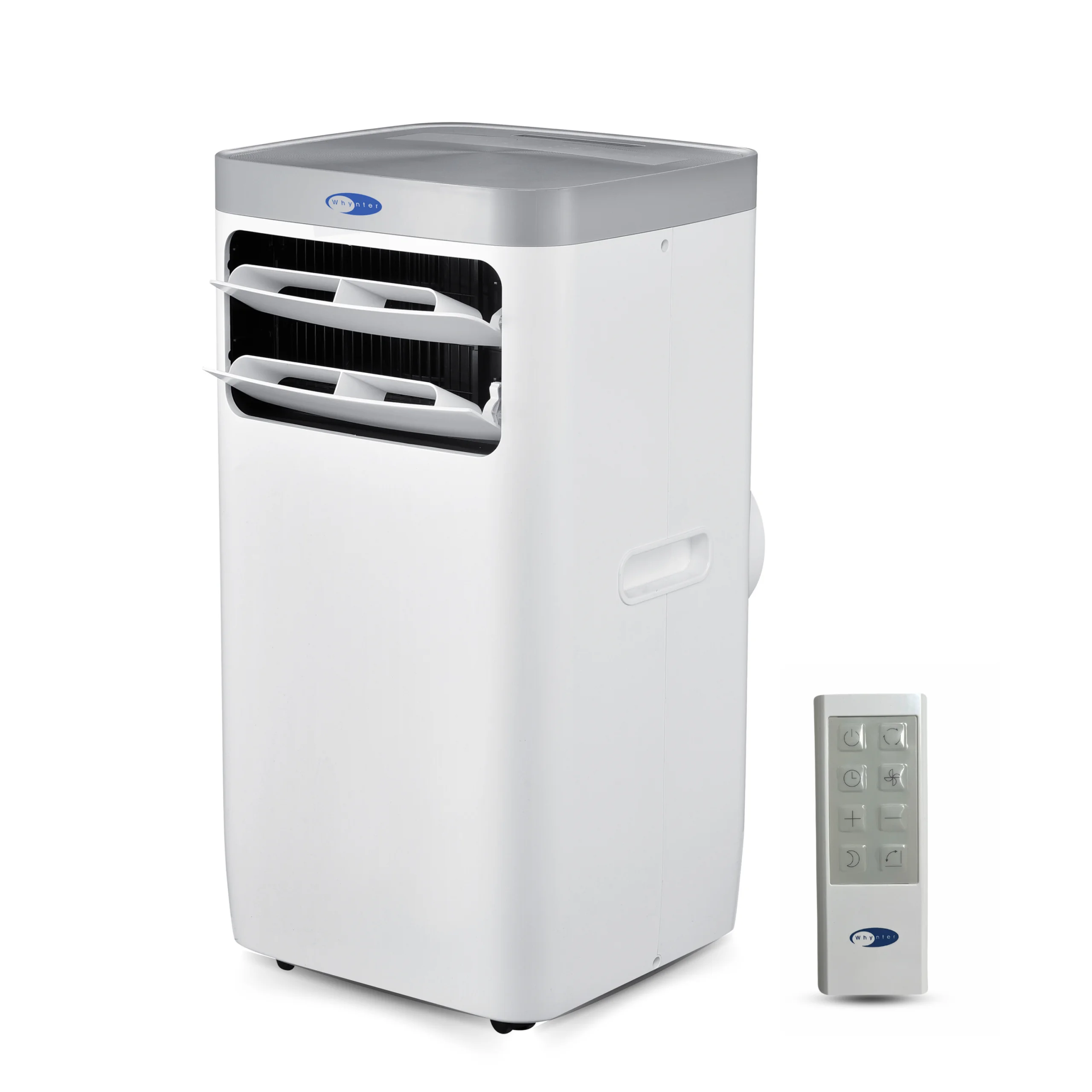
The Whynter ARC-115WG is a compact, cooling-only portable air conditioner. One unusual point deserves attention before comparing it: Whynter’s current product title and URL say “11,500 BTU dual hose,” but the exact model’s specification table says 11,000 BTU/h ASHRAE, 6,800 BTU/h SACC and single hose. The older exact-model page and both model-named manuals also identify the ARC-115WG as an 11,000/6,800 single-hose unit. The model-specific data, not the URL wording, is the safer basis for a shortlist. Its 6,800 SACC is the DOE capacity to compare with other current portable ACs; the 400-square-foot coverage is Whynter’s estimate, not a guarantee for every room or heat load.
Plan for one hose and a modest window span
For cooling, the manual requires the 5.5-inch exhaust hose to carry hot air outside. The included adjustable window panel is listed for a clear opening from 20 to 46 inches, and the extendable hose is up to 59 inches long. Keep the hose short and straight, as Whynter advises, and leave about 20 inches around the unit for air circulation. This is a relatively narrow panel span compared with Whynter’s current ARC-1280 NEX pair, whose documented panel starts at 28.7 inches and extends much farther. Measure the actual window track and cabinet location; the room still needs a workable route for the hose and access to a grounded outlet. The manual says not to use an extension cord or share the outlet with other appliances.
The case is listed at 14.75 inches wide and 28 inches high. Depth appears as 13.75 inches in the current product data and 2024 manual, but 14 inches in the 2021 manual, so allow the larger figure plus clearance for the rear hose. Weight is more unsettled: the current legacy page lists 51.25 pounds, while the 2021 and 2024 manuals list about 56.2 pounds. The casters help on a smooth floor, but a strict lifting limit cannot be confirmed from those conflicting listings. The newer manual also says to let the unit stand upright for about four hours before plugging it in after transport.
Useful simple modes, but no heating or connected control
The ARC-115WG provides Cool, Dry and Fan modes, three fan speeds, a remote and a 24-hour timer. Its 2024 manual also documents sleep mode, adjustable louver swing and automatic restart after a power interruption. The thermostat range is 61–89°F. There is no heat mode; it cannot cover winter heating as a heat-pump model can. No Wi-Fi or app control is documented, so do not assume that a remote-controlled model is connected. In Cool mode, the exhaust hose must be fitted. In Fan and Dry, the hose can be removed if you do not want heat exhausted outdoors.
Automatic evaporation does not remove every water chore
Whynter rates dehumidification at 87 pints per day and describes automatic evaporation in most conditions below 70% relative humidity. Its manual says that above 70%, about 98% of the moisture is expelled and the remaining 2% collects in the internal tank. When the tank reaches its limit, the unit pauses operating modes while the fan may continue; it must be drained before cooling or dehumidifying resumes. You can drain the lower port manually. An upper gravity port supports continuous drainage, but its hose is optional and sold separately; there is no lift pump. Dry mode can run without the exhaust hose, but the manual warns that unvented use may require more frequent draining and offers no humidity setpoint. Anyone expecting a hose-free dehumidifier should account for that rather than treating “auto drain” as a guarantee.
Filter and efficiency details have limits
The washable filter catches larger particles such as dust and pet hair; Whynter recommends cleaning it about every two weeks, or more often when airflow is visibly restricted. The manufacturer’s sound figures are below 49 dBA on low and below 52 dBA on high, not measurements made in a bedroom. The 2021 manual prints CEER 6.81 and EER 9.88, but the 2024 manual does not repeat those efficiency entries and the exact EnergyGuide value is not confirmed here. The finder therefore will not treat a manual figure as an exact-label CEER. Whynter’s 2024 manual states one year of limited parts coverage and three years on the compressor; read the current warranty and seller terms before purchase.
Who should consider the ARC-115WG?
It is worth comparing if you want a relatively narrow single-hose cabinet, need a 6,800-SACC cooling tier, have a 20-to-46-inch opening and are comfortable with manual or optional gravity drainage. It is a poor fit if you need dual-hose intake and exhaust, heat, app control, a confirmed maximum lifting weight or an exact EnergyGuide efficiency threshold. The Whynter ARC-1280WX/MX is a larger dual-hose alternative with a documented 10,000-SACC rating, inverter and app plan; it also needs a wider panel and two hose paths. The choice is not simply “compact versus powerful”: first check whether the rating, window and water plan suit your room.
This assessment is based on manufacturer documents, not hands-on cooling, energy, sound or durability testing. Check the exact model and package before planning an installation: Whynter’s current ARC-115WG page, legacy exact-model listing, 2021 manual and 2024 manual. For the higher-capacity dual-hose alternative, compare the ARC-115WG versus ARC-1280 guide.
Key details at a glance
| DOE seasonal-adjusted cooling capacity | 6800 BTU/h |
|---|---|
| Manufacturer's stated room area | 400 sq ft (stated, not a guarantee) |
| Documented modes | cool / fan / dry |
| Dual-hose exhaust arrangement | No |
| Manufacturer's lowest sound claim | 49 dBA (claim, not our measurement) |
| Cabinet width | 14.75 in |
| Cabinet height | 28 in |
| Cabinet depth | 14 in |
| Listed limited warranty | 1 years |
| Window-kit minimum width (where exact manual confirms) | 20 in |
| Window-kit maximum width (where exact manual confirms) | 46 in |
| Built-in condensate pump | No |
| Supplemental heat documented | No |
Use the exact model’s instructions for operating limits, supplied equipment and version differences.
Sources for this assessment
- Whynter exact current U.S. ARC-115WG product page (the SKU specification differs from the page URL/title)
- Whynter legacy exact ARC-115WG U.S. product page
- Whynter current product page-linked 2021 ARC-115WG owner manual
- Whynter legacy product page-linked 2024 ARC-115WG owner manual
- Whynter exact ARC-115WG EnergyGuide linked from the legacy product page
- Whynter page-linked ARC-115WG product image, personally viewed

Keep the model number in the decision.
Check the listed suffix, included vent kit, room conditions and service instructions before ordering.