
Your needs, this model
Does it fit your priorities?
Will its documented 5,900-BTU/h SACC meet a 5,000-BTU/h minimum?
Yes. The exact page rates this model at 5,900 SACC; it does not reach a 6,000-BTU/h threshold.
Explore this need in the finder →Is a dual-hose installation documented?
Yes. The exact page and manual identify a large exhaust and separate smaller intake hose.
Explore this need in the finder →Will the listed cabinet height clear a strict 30-inch maximum?
No. Both page and manual list 30.5 inches high.
Explore this need in the finder →A lower SACC dual-hose option with its own specification conflicts
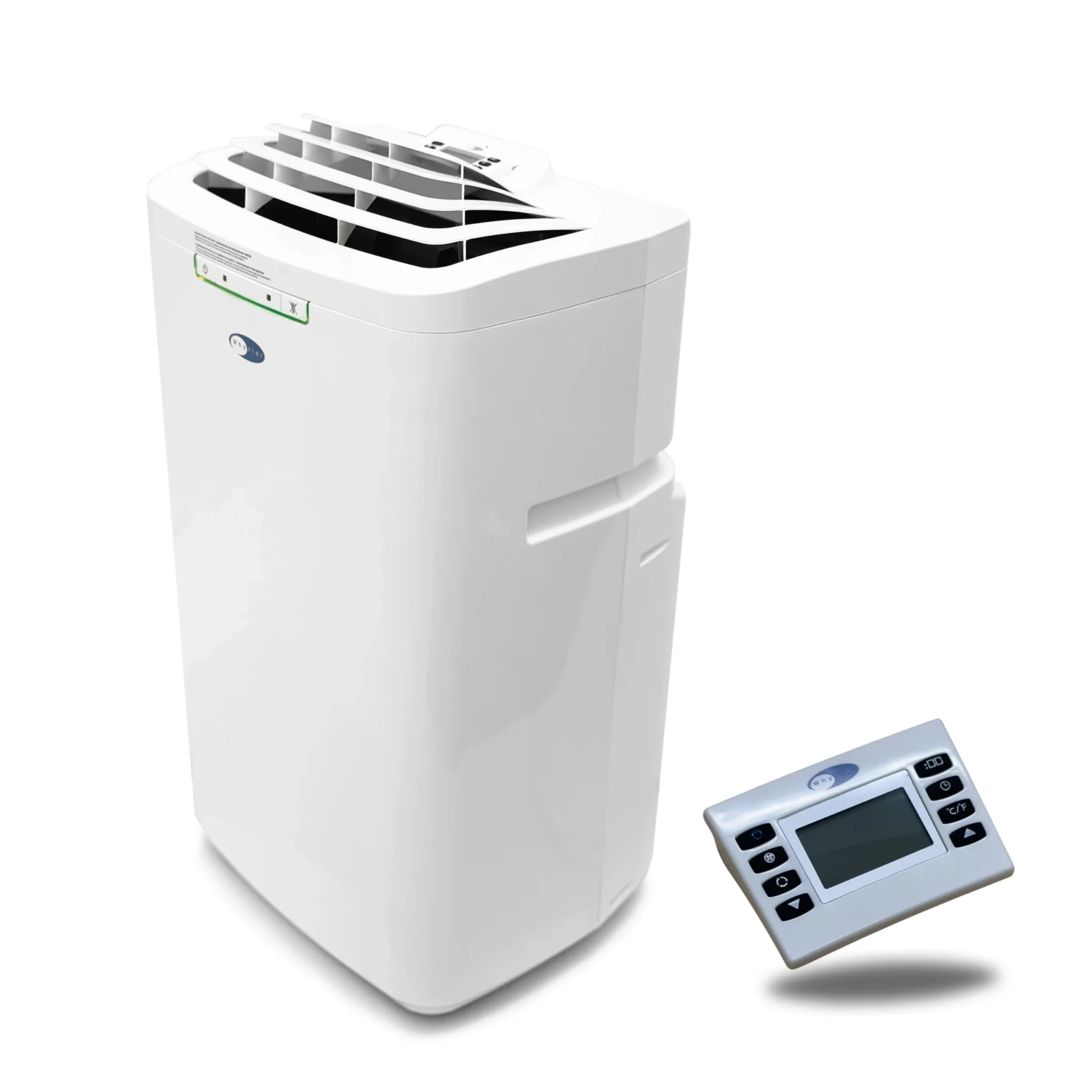
The Whynter ARC-110WD is a white, cooling-only portable AC. Its current exact product page identifies 11,000 BTU/h cooling and 5,900 BTU/h SACC, a dual-hose layout and a manufacturer estimate for rooms up to 350 square feet. Use 5,900 SACC—not 11,000 ASHRAE—as the portable-unit comparison figure. The stated area is not a guarantee: direct sun, poor insulation, high ceilings, doors left open and heat from equipment can all change the load.
This is not a heat model, despite the broader product category. It offers automatic, cool, dry and fan operation, four fan speeds, a timer and a remote. The manual and exact page identify one large exhaust hose and one smaller condenser intake hose. That distinction may matter if you are comparing it with a single-hose unit or trying to route the kit through a tight opening.
Fit the window kit and the cabinet before ordering
Whynter lists the kit at 20–46 inches. Its manual notes that the slider can be cut below the listed minimum only without damaging hose openings; a wider opening requires another panel arrangement or an additional slider. The exhaust run should remain short and straight; the manual warns not to extend total length beyond nine feet. Measure the clear track span and also allow space for both rear hoses, air intake and movement of the cabinet.
The product page lists the cabinet as 17.5 by 15.5 by 30.5 inches, while its manual lists 17.3 by 15.4 by 30.5. The shared height is clear, but width and depth are not exact matches across the two documents. Both list net weight at 62 pounds. Do not treat a fractional-inch cabinet clearance as settled without checking the rating plate or actual unit. The casters help on smooth, flat flooring, but a 62-pound appliance still needs a plan for stairs and thresholds.
Automatic evaporation is conditional
The product page describes a self-evaporating design that manages most or all condensate in many environments and says an upper gravity drain port is provided. The manual explains the limits: it rates dehumidification at 81 pints per day, but high humidity can leave moisture in the internal reservoir. It provides lower-port manual drainage and an upper continuous gravity option, with the drain hose sold separately. The exact product page says Pump Feature: No. A lift pump should not be assumed from the term “self evaporating.” If uninterrupted use in a humid room is important, arrange a safe downward gravity route and be prepared to drain if the reservoir warning appears.
The washable pre-filter should be cleaned at least every two weeks according to the manual, then dried before reinstalling. The activated-carbon filter is not washable and is replaced as needed, usually every two to three months. This is ordinary recurring upkeep. The manual also calls for upright transport, a grounded receptacle and no extension cord.
Use the EnergyGuide and manual as different pieces of evidence
The ARC-110WD EnergyGuide names the exact model and shows a $352 estimated annual operating cost and 2,935 kWh estimated yearly use. Those are standardized label estimates, not a promise about a specific electric bill. The manual reports CEER 6.47 and EER 7.81, but the EnergyGuide itself does not display a CEER value. Since the label-based efficiency comparison uses the exact EnergyGuide CEER, that value remains unknown rather than importing the manual’s figure into the label slot.
There is also a maximum-power disagreement. The page’s specification box says 1,000 watts/9.2 amps, while its feature list and manual technical data say 1,040 watts/9.5 amps. I do not present one of those figures as settled. The manufacturer’s noise claims are below 51 dBA on low and below 56 on high; no independent sound test is available here. Listed warranty coverage is one year on the unit, with three years on the compressor.
Who should consider it?
ARC-110WD is worth comparing when a 5,900-BTU SACC dual-hose system and no heating meet your needs, a 20–46-inch window installation works and you are comfortable with the product/manual measurement and power disagreements. It has a smaller cabinet than the 34-inch-tall ARC-12SD, but not a settled exact width/depth pair across sources. The gray ARC-131GD is a higher ASHRAE-labelled dual-hose sibling with a conflicting SACC; because the latter is unresolved, it should not replace the 110WD when a minimum DOE capacity is essential. The ARC-12S is a single-hose alternative rated 5,000 SACC with a smaller 31-inch cabinet.
Consult the exact ARC-110WD page, manual and EnergyGuide. This review interprets product documentation; it is not a hands-on test and does not claim measured cooling, reliability, owner experience, current price or stock.
Key details at a glance
| DOE seasonal-adjusted cooling capacity | 5900 BTU/h |
|---|---|
| Manufacturer's stated room area | 350 sq ft (stated, not a guarantee) |
| Documented modes | auto / cool / dehumidify / fan |
| Dual-hose exhaust arrangement | Yes |
| Manufacturer's lowest sound claim | 51 dBA (claim, not our measurement) |
| Cabinet width | 17.5 in |
| Cabinet height | 30.5 in |
| Cabinet depth | 15.5 in |
| Listed product weight | 62 lb |
| Listed limited warranty | 1 years |
| Window-kit minimum width (where exact manual confirms) | 20 in |
| Window-kit maximum width (where exact manual confirms) | 46 in |
| Built-in condensate pump | No |
| Supplemental heat documented | No |
Use the exact model’s instructions for operating limits, supplied equipment and version differences.
Sources for this assessment
Keep the model number in the decision.
Check the listed suffix, included vent kit, room conditions and service instructions before ordering.