
Your needs, this model
Does it fit your priorities?
Does the ARC-102CS meet a minimum 7,100-BTU/h SACC requirement?
No. Whynter's current page and exact manual list 7,000 BTU/h SACC, below 7,100.
Explore this need in the finder →Can the documented cabinet fit a 15-inch maximum depth?
Yes. Whynter's current page and exact manual list 14 inches of depth; confirm rear clearance for the exhaust connection.
Explore this need in the finder →Can the ARC-102CS satisfy an essential heat requirement?
No. Whynter explicitly lists Heat Mode: No and documents Cool, Dehumidify and Fan modes only.
Explore this need in the finder →Is an exact manufacturer EnergyGuide CEER of at least 8 documented?
No. The exact linked EnergyGuide returned 404; the manual's 6.9 CEER is not used as a verified label value.
Explore this need in the finder →Can this model be confirmed for a 40-inch window-panel span?
Not from the current evidence. The manual and product page disagree about the panel range, so a 40-inch essential fit limit remains unknown to the matcher.
Explore this need in the finder →Is app or Wi-Fi control documented for the ARC-102CS?
No app or Wi-Fi feature is documented in the exact current specification or named manual; an essential connected-control need cannot be confirmed.
Explore this need in the finder →Use 7,000 BTU/h SACC to size this one
Whynter's ARC-102CS page leads with 10,000 BTU, but its exact specification table and the model-named manual identify 7,000 BTU/h SACC. Those are different capacity methods, not two interchangeable ways to meet the same minimum. For a shortlist that uses DOE-style SACC, this is a 7,000-BTU/h unit: it meets a 6,000-BTU/h floor, but not a 7,100- or 8,000-BTU/h requirement. Whynter estimates coverage up to 300 square feet; that is a manufacturer planning figure, not a guarantee for a sunny room, high ceiling, leaky space or equipment-heavy office.
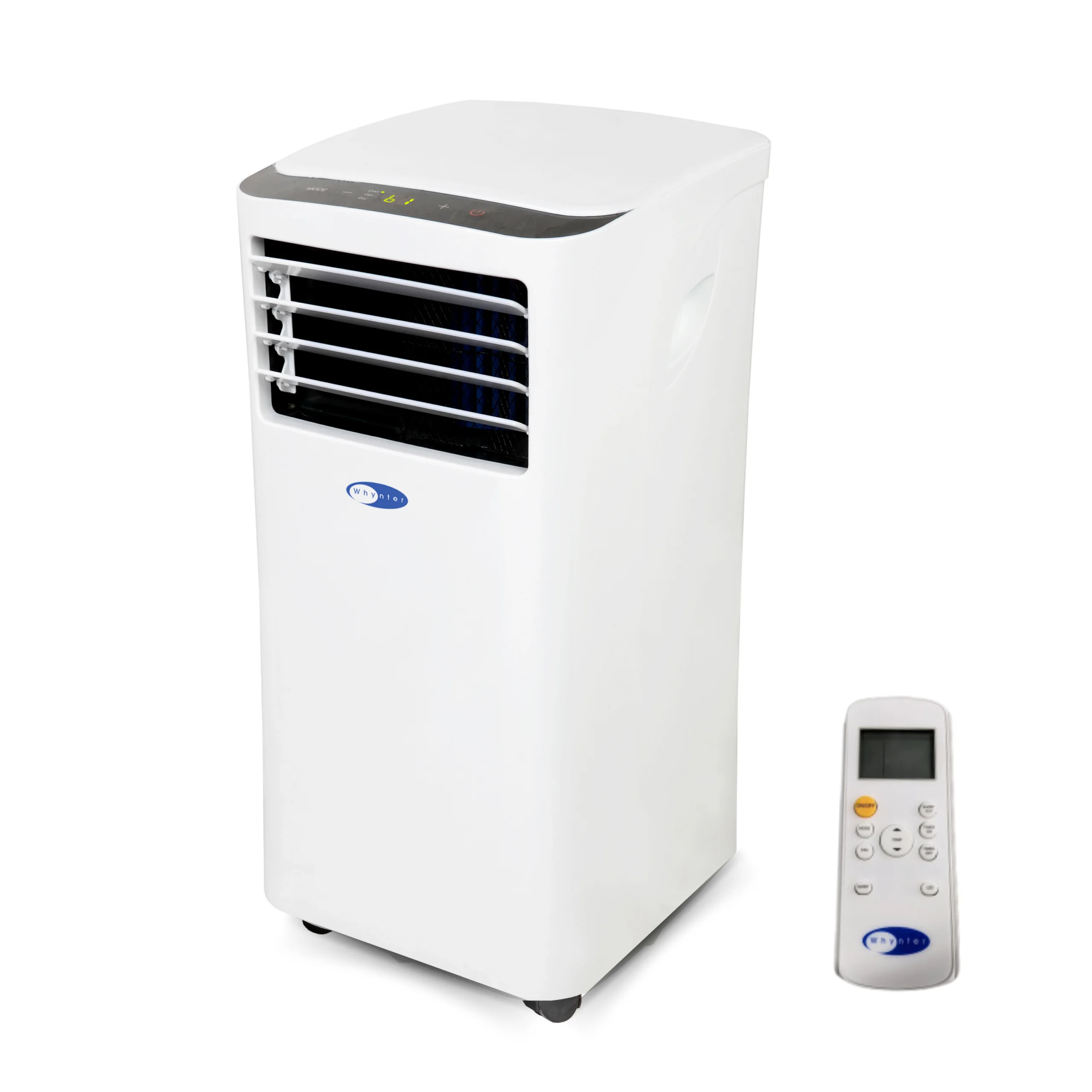
A compact cabinet still needs a workable exhaust route
The current page and exact 2024 manual agree on a 14-inch-wide, 14-inch-deep and 28-inch-high cabinet, with a listed weight of 53 pounds. Those dimensions are genuinely useful when the floor spot is tight, though the hose connector and rear air intake need room as well. The wheels help on a smooth floor; the manual cautions against rolling the unit over thick carpet or obstacles. It is a compact appliance to move between nearby rooms, not a lightweight cooler to carry casually up stairs.
For cooling, its single 6-inch exhaust hose must carry hot air outside. The product page says the included three-piece panel can extend to 82 inches, while the exact manual's technical table says 26.5 to 48 inches; elsewhere in that same manual the accessory table gives a 26.75-inch minimum and 48-inch maximum. Because the short span is inconsistent and the page's maximum is much longer than the manual's, an opening measurement cannot be treated as a confirmed fit from this material alone. Measure the sash and check the exact kit in the carton or with Whynter before choosing this model for a narrow or unusually tall opening. Its hose is listed up to 59 inches, so the unit also has to sit close enough to the opening for a short, unstrained route.
Simple modes and remote operation
The ARC-102CS provides Cool, Dehumidify and Fan modes, two fan speeds, a digital remote, a 24-hour timer and automatic restart after a power interruption. The thermostat range is listed as 62–86°F. There is no heat mode, and the exact page and named manual do not document Wi-Fi or app control. If heating or connected control is essential, do not treat its cooling modes or remote as substitutes. The manual also describes a roughly three-minute compressor delay after cooling starts and recommends letting the unit stand upright for about four hours before first connection after transport.
Plan for water even with self-evaporation
Whynter describes an automatic evaporation system, but its manual qualifies the claim: in environments below 70% relative humidity, condensate is normally exhausted through the hot-air hose. Above that level, it says about 98% is expelled and the rest can collect in the internal tray. When the tray reaches its limit, P1 appears and normal operating modes stop until the water is drained. That makes the automatic system a convenience, not a promise that the unit will never need attention in muggy weather.
The manual shows two practical routes. For manual draining, remove the lower plug and empty the tray into a safe receiver. For continuous drainage, attach the supplied hose to the upper port and route it downward by gravity to a drain; the hose must not rise or kink, because there is no lift pump. In Dry mode, a gravity route is valuable if you want longer unattended operation. The washable pre-filter should be cleaned about every two weeks, and the included activated-carbon filter is listed for replacement every two to three months. Keep the filters installed and use the grounded outlet specified by the manual.
Published claims do not settle every comparison
The exact current page lists 70 pints per day of dehumidifying capacity; the manual and older Whynter listing say 68. The page's specification block says below 50 dBA while its feature list says below 51, and the manual also says below 51. These are manufacturer claims, not room measurements. More importantly, the exact 2024 manual prints CEER 6.9, but Whynter's model-specific EnergyGuide link on the legacy product page returned 404. The label's CEER, yearly kilowatt-hours and estimated cost therefore remain unverified; the finder will not treat the manual figure as an exact-label efficiency result.
Where it fits among other single-hose choices
Consider the ARC-102CS when you need a 7,000-BTU/h SACC cooling tier, value its small cabinet and can confirm a compatible window panel. If floor footprint matters more than capacity, the Midea MAP06S1JWT-B is narrower and shallower, but it is a 6,000-BTU/h SACC model for a smaller stated room area. If you need a stronger capacity tier and app control, the Whynter ARC-0850XP is listed at 8,000 BTU/h SACC and has Wi-Fi features, although its page and manual conflict on cabinet dimensions and weight. Those distinctions matter more than the 10,000-BTU headline on the ARC-102CS. See the three-model comparison by cooling capacity and footprint before deciding.
The manufacturer's source trail matters for this model: the current page and named manual agree on its compact cabinet and 7,000-BTU/h SACC, but not on all drainage, sound, humidity-removal and window-panel details. Check the ARC-102CS suffix, its included slider and the energy label on the actual unit you are considering. This assessment reports manufacturer documentation; I have not measured its cooling, energy use, noise or durability.
Primary references: Whynter's current ARC-102CS page, legacy exact-model page and 2024 user manual.
Key details at a glance
| DOE seasonal-adjusted cooling capacity | 7000 BTU/h |
|---|---|
| Manufacturer's stated room area | 300 sq ft (stated, not a guarantee) |
| Documented modes | cool / dehumidify / fan |
| Dual-hose exhaust arrangement | No |
| Cabinet width | 14 in |
| Cabinet height | 28 in |
| Cabinet depth | 14 in |
| Listed product weight | 53 lb |
| Listed limited warranty | 1 years |
| Built-in condensate pump | No |
| ASHRAE cooling rating (separate test method) | 10000 BTU/h |
| Supplemental heat documented | No |
Use the exact model’s instructions for operating limits, supplied equipment and version differences.
Sources for this assessment
- Whynter current exact ARC-102CS product page
- Whynter legacy exact ARC-102CS product page
- Whynter exact ARC-102CS 2024 user manual, version v050724
- Whynter current-page-linked ARC-102CS troubleshooting sheet
- Whynter EnergyGuide URL linked by its exact legacy ARC-102CS page; direct request returned 404
- Exact current ARC-102CS product-page image, archived from Whynter

Keep the model number in the decision.
Check the listed suffix, included vent kit, room conditions and service instructions before ordering.