
Your needs, this model
Does it fit your priorities?
Can this exact configuration heat if I can route the required drain hose?
Yes. The exact manual identifies Heat Pump mode, 41–86°F ambient limits and a drain hose required during heating; one hose-in-hose window setup can be evaluated with that routed drain plan.
Explore this need in the finder →Does the EnergyGuide establish a 12,000-BTU/h DOE/SACC minimum?
No. The two labels state a 12,000-BTU capacity field but do not identify it as DOE/SACC; that hard requirement is not established.
Explore this need in the finder →Must the heat pump operate without a drain hose?
This model does not fit that plan: its exact manual explicitly requires a drain hose during heat-pump operation.
Explore this need in the finder →The Toshiba RAC-PT1412HVWRU has a documented heat-pump operating plan that changes the room, window and drainage questions more than its headline capacity. Its exact Toshiba manual identifies the model, lists Cool, Dry, Fan and Heat Pump operating ranges, and requires a drain hose in heat mode. Its manufacturer EnergyGuide labels the capacity as 12,000 BTU, but two preserved EnergyGuides for the same model disagree on CEER: one says 12.3 and $70 estimated annual cost, the other 14.2 and $65. Without a clear revision or supersession link, neither efficiency value is used for a hard filter.
Keep the rating dispute and capacity basis visible
For RAC-PT1412HVWRU, both labels identify the exact model and 12,000-BTU capacity figure, but do not explicitly state the DOE/SACC basis used by this finder's cooling threshold. A 12,000-BTU DOE minimum is therefore not established. The CEER conflict matters for anyone who wants a minimum efficiency rating: the lower label might pass a 12.0 threshold while the higher one would pass more, but there is not enough evidence to select one as controlling. The safe decision is that a CEER minimum above 12.3 is not documented, and even 12.3 itself needs source-version clarification.
The labels also differ in standardized yearly cost by five dollars. Those estimates use label assumptions, not an individual utility bill, local climate or specific usage hours. No price, retailer stock or tested cooling output is asserted. If a particular listing is under consideration, ask for a photograph of the unit's own EnergyGuide and data label and match that revision to the included documentation rather than choosing whichever rating appears more favorable.
Heat is real, but it brings a drain requirement
The exact-model Toshiba manual supports Heat Pump mode from 41°F through 86°F ambient temperature. That is a useful planning boundary, not a guarantee of room comfort at every outdoor condition. The manual says that heat-pump operation produces condensate and that the drain hose must be installed for heating; it lists a hose and universal drain adapter among the accessories. A longer 3/4-inch hose can be attached to the adapter. If you cannot route water to a drain while the appliance heats, this is not a match even if you like the heating feature. Do not judge heat capability from a nearby cooling-only model or assume the regular full-tray warning replaces the heat drain.
The same exact manual describes a built-in condensate pump and permits the continuous hose to rise up to six feet, with a downward-facing hose end. It also has a separate instruction for continuous drainage in Dry mode. Because the heat-mode paragraph still requires installation of a hose and points it to a drain area, plan the hose route before choosing a heating setup; do not kink or overextend it. In Dry mode, the exhaust arrangement is different from Cool/Heat and the upper drain outlet is used. These mode-specific instructions mean one generic “drains automatically” claim would be misleading.
Check the hose-in-hose layout and unusually wide slider range
The manual diagram labels separate inlet and outlet air hoses and tells the installer to keep twenty inches clear around them. This is a hose-in-hose arrangement rather than the one-exhaust-hose plan used by the PD pair. Both paths need a route to the window and room clearance; avoid tight bends, pinching or a cabinet position that blocks the inlet. The included adjustable kit is documented for openings from 19.1 to 63.8 inches. A 40-inch clear opening is inside that range, but measure the actual sash track and verify the seller's panel, brace, seals and adapter pieces. The manual lists optional cutting tools for setup, but no unsupported cut-panel minimum is assumed here.
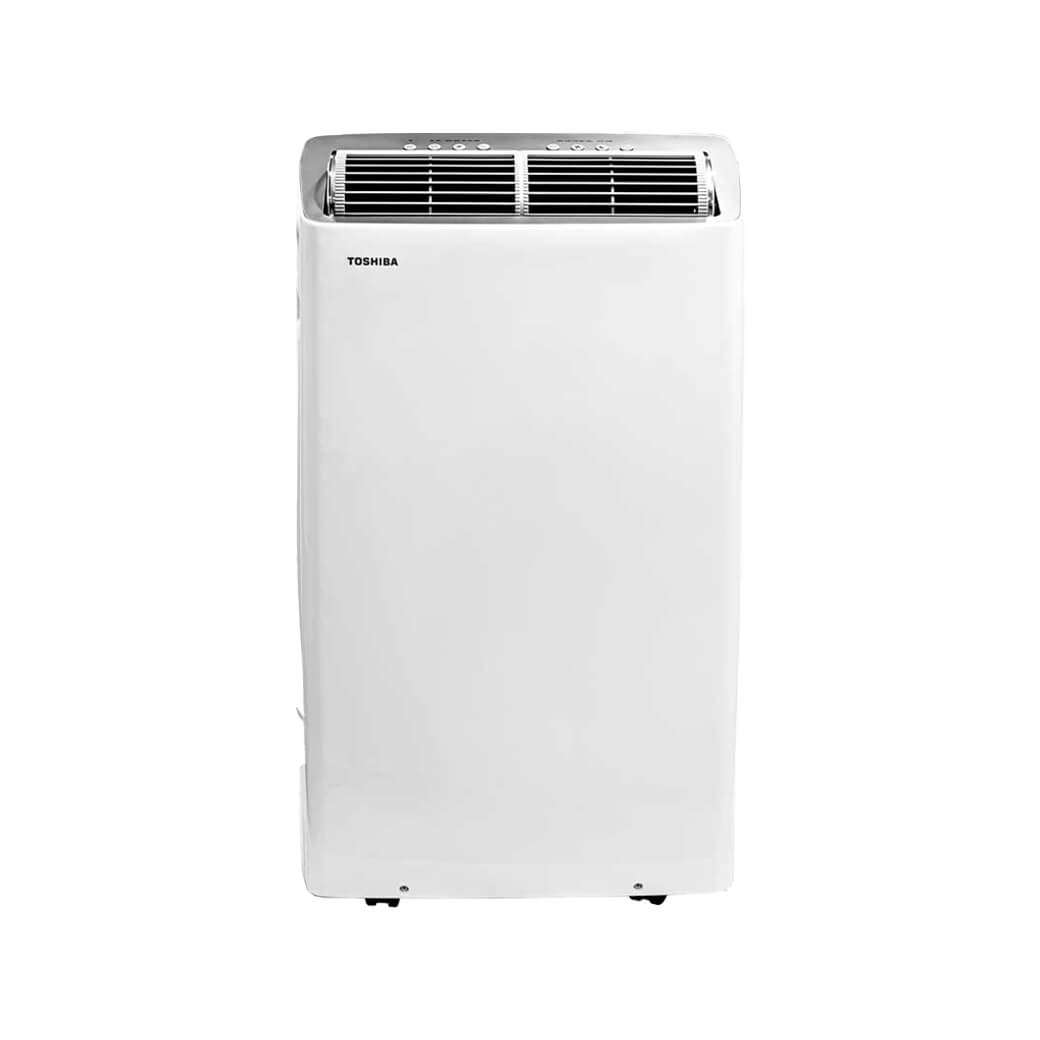
The front image shows a white Toshiba cabinet, but the source set does not provide verified body dimensions, mass, room-size band, warranty, explicit inverter status, or heating BTU output. “Smart inverter” wording in an old or inaccessible page path is not promoted into a product feature without a readable exact product specification. The exact manual does include a Connect button and wireless/app setup instructions, so connected control is documented; we have not tested pairing or whether today's app remains supported.
Who should choose this kind of older configuration?
The PT1412HVWRU is relevant when heat is essential, the required heat drain hose can be routed, the dual-hose panel suits the opening, and a specific earlier offer's model label is visible. It should not be shortlisted for a hard DOE capacity threshold, a CEER cutoff that relies on the unresolved EnergyGuide, a specific height/weight limit, or a current warranty expectation. If you need a single-hose portable AC, compare the PD-series instructions, but those two models have no confirmed DOE rating basis either. If heat is not needed and a current exact DOE rating matters, a currently documented alternative may make the decision clearer.
This earlier-model review is based on the exact model-named Toshiba manual and two original Toshiba U.S.-hosted EnergyGuides, plus a visually inspected manufacturer-supplied image whose photo-versus-render status is uncertain. The Toshiba U.S. category and tested product routes now redirect to the homepage; that fact does not prove a complete historical inventory or retailer stock. No invented price, ASIN, ownership claim, lab result or availability claim is included. Check the cabinet's full RAC-PT1412HVWRU code and the matching label revision before comparing any offer.
Sources and limits
Read the Toshiba RAC-PT1412HVWRU owner's manual (third-party-hosted copy of the exact-model manual), the EnergyGuide labelled CEER 14.2 and the separate EnergyGuide labelled CEER 12.3. Both label files remain preserved; the record does not choose between them.
Key details at a glance
| Documented modes | cool / dry / fan / heat |
|---|---|
| Dual-hose exhaust arrangement | Yes |
| App or connected control | Yes |
| Window-kit minimum width (where exact manual confirms) | 19.1 in |
| Window-kit maximum width (where exact manual confirms) | 63.8 in |
| Built-in condensate pump | Yes |
| Minimum whole-degree ambient for heat-pump operation | 41 °F (manual) |
| Supplemental heat documented | Yes |
Use the exact model’s instructions for operating limits, supplied equipment and version differences.
Sources for this assessment
Keep the model number in the decision.
Check the listed suffix, included vent kit, room conditions and service instructions before ordering.