
Your needs, this model
Does it fit your priorities?
Do you need both the 12,000-BTU DOE tier and a documented heat-pump mode?
Midea lists the MPT1412HVRU at 12,000 BTU DOE with Heat Pump operation, but the manual sets an ambient operating range of 41-86 F.
Explore this need in the finder →Does the exact MPT1412HVRU use the dual-hose Duo layout?
Yes. Midea identifies the hose-in-hose Duo arrangement; it is not the single-hose MPX cooling-only family.
Explore this need in the finder →Can you route a drain hose whenever you use its heat-pump mode?
Yes is essential for this model: its manual says Heat mode produces condensate and requires the drain hose; the integrated pump’s six-foot elevation instruction applies to Dry mode.
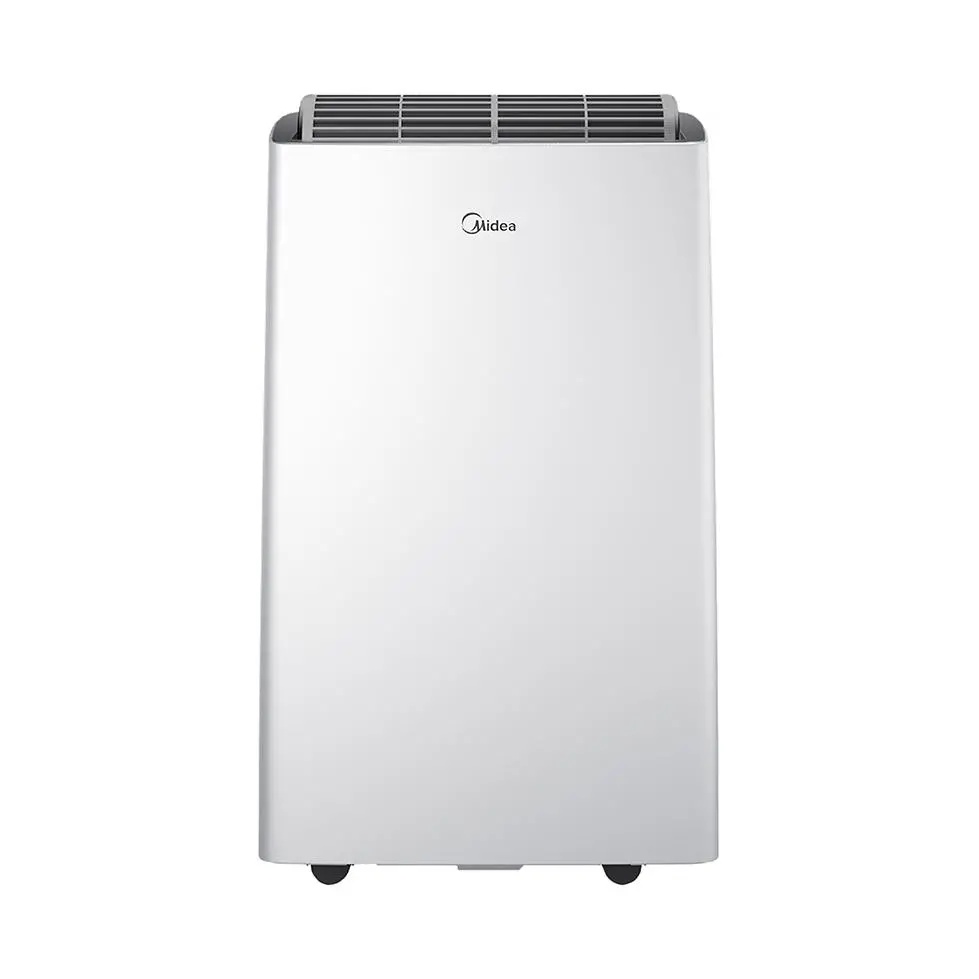
Explore this need in the finder →The Midea MPT1412HVRU is a 12,000-BTU DOE Duo portable air conditioner with a heat-pump mode. Its strongest reason to shortlist it is not a vague all-season label: Midea documents both the cooling tier and a real heating mode, and the owner manual explains the drain and temperature limits that come with heating. If your room needs cooling only, its heavier heat-pump hardware and extra setup are not automatically an advantage.
Keep its rating and room estimate in perspective
Midea identifies this exact model as 12,000 BTU DOE and estimates coverage up to 550 square feet. That area figure is a manufacturer guide, not a room-load calculation or a guarantee that the unit will hold a target temperature. Sun exposure, ceiling height, insulation, open doorways and heat-producing equipment all change the load. Compare DOE ratings with other DOE/SACC figures rather than a different test method's headline. The exact evidence reviewed here does not establish a separate ASHRAE rating or a numeric CEER, and the page's “40% energy savings” statement is a comparison with DOE minimum-efficiency requirements, not an annual-bill forecast.
The page describes a Duo hose-in-hose arrangement and inverter control. That configuration is materially different from a conventional single-hose appliance: it is intended to use a paired exhaust path at the window, so check that you can place the unit near the opening without twisting or stretching the hose. Inverter operation is a manufacturer-listed feature, not a promise of a particular room temperature, sound level or electric bill.
Heat is useful, but it has a drain requirement
The manual gives a heat-pump operating range of 41–86°F ambient and a 60–86°F set-temperature range. It also explicitly says that heat-pump operation produces condensate and that the drain hose must be installed in Heat mode. The kit table lists a drain hose and a heat-mode adaptor. In other words, do not interpret the built-in condensate pump as a way to avoid planning a drain route while heating: the manual calls for a hose in that mode.
There is a separate pump detail for Dry mode. Midea says the unit contains a condensate pump and that, during Dry-mode continuous drainage, the hose can be elevated up to six feet. That statement is tied to Dry mode in the instructions; it should not be used to invent a heat-mode lift limit. If your drain sits far away or higher than the permitted arrangement, confirm the exact mode-specific routing before installation. When the lower collection tray reaches its limit, a P1 indication stops cooling or dehumidification until the tray is drained.
Measure the window and the actual hose path
The included slider kit is specified for 19.1–63.8-inch openings. The manual provides panel combinations for that full standard range and says a saw can be used to shorten the adapter for a narrow window. It does not give a post-cut minimum, so an opening below 19.1 inches still needs a careful physical check rather than an assumed fit. The manual also calls for a level location at least 9.8 inches from the nearest wall and about 19.7 inches around the hose outlet; it warns against bending or overextending the hoses and asks for roughly 20 inches of clearance near the inlet and outlet. Measure the assembled cabinet, opening, kit and route—not just the window width.
The listed cabinet is 19.53 inches wide, 32.48 inches tall and 16.73 inches deep, at 77.16 pounds. Check doorway turns and the destination floor before moving it. These are body dimensions; they do not replace the hose and airflow clearances in the manual.
Connected controls and upkeep
Midea lists SmartHome app, smartwatch and voice-assistant control. The manual describes wireless pairing, timer and remote functions. Treat these as manufacturer-stated conveniences; no network, voice-assistant or sound testing is claimed here. The page says operation can be as low as 42 dB, which is a stated low-end claim rather than an independent measurement. A washable filter needs cleaning every two weeks. Before storage, Midea instructs owners to drain the tray, clean and dry the filter, and run Fan mode for 12 hours in a warm room.
Which setup does it suit?
Consider the MPT1412HVRU when 12,000 BTU DOE addresses a real cooling need, you also value a documented heat pump, a 77-pound cabinet and its hose arrangement fit the room, and you can route a drain during heating. It is a poor match for a narrow opening that depends on an unverified cut-panel minimum, a room where a 32.48-inch cabinet cannot fit, or a heating plan below the documented 41°F outdoor limit. The manual lists a three-year full warranty from delivery or purchase date, whichever is later; read the complete current warranty terms before relying on that duration.
If you do not need heat, Midea's separate MAP14S1TBL-A is another 12,000-BTU DOE Duo, but it is a different cooling-only configuration and weighs 73.85 pounds in its exact listing. For a smaller and lighter cooling-only unit, the MPX0812CWRU is an 8,000-BTU DOE single-hose model at 61.38 pounds, with a narrower body; it cannot replace this product's heating function or dual-hose layout. No laboratory cooling, heating, energy, sound or durability results are asserted for any of these models. Match the exact suffix, opening, route and service instructions to your own installation rather than choosing by a room-size number alone.
Key details at a glance
| DOE seasonal-adjusted cooling capacity | 12000 BTU/h |
|---|---|
| Manufacturer's stated room area | 550 sq ft (stated, not a guarantee) |
| Documented modes | cool / heat / dehumidify / fan |
| Dual-hose exhaust arrangement | Yes |
| Variable-speed inverter | Yes |
| App or connected control | Yes |
| Manufacturer's lowest sound claim | 42 dBA (claim, not our measurement) |
| Cabinet width | 19.53 in |
| Cabinet height | 32.48 in |
| Cabinet depth | 16.73 in |
| Listed product weight | 77.16 lb |
| Listed limited warranty | 3 years |
| Window-kit minimum width (where exact manual confirms) | 19.1 in |
| Window-kit maximum width (where exact manual confirms) | 63.8 in |
| Built-in condensate pump | Yes |
| Minimum whole-degree ambient for heat-pump operation | 41 °F (manual) |
| Supplemental heat documented | Yes |
Use the exact model’s instructions for operating limits, supplied equipment and version differences.
Sources for this assessment
Keep the model number in the decision.
Check the listed suffix, included vent kit, room conditions and service instructions before ordering.