
Your needs, this model
Does it fit your priorities?
Does the white MAP14AHS1TWT provide heat?
Yes. Its exact Midea listing says Heat: Yes, and the manual cover explicitly names MAP14AHS1TWT as a covered model.
Explore this need in the finder →Can I use heat mode without providing a drain route?
No. The exact model-named manual says condensate is produced in heat-pump mode and a drain hose must be installed.
Explore this need in the finder →Does the white older model fit a 30-inch cabinet-height maximum?
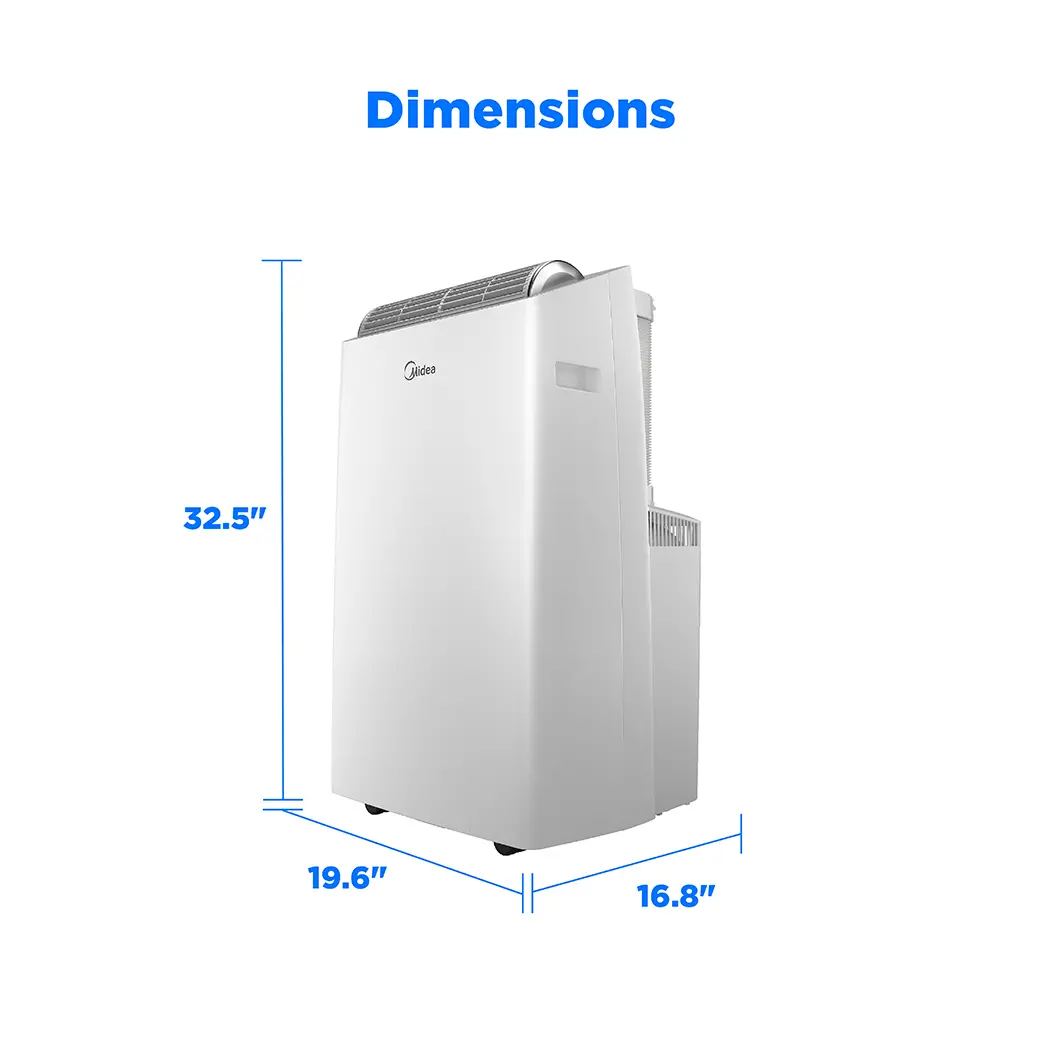
No. Midea lists it at 32.48 inches high; a tighter limit is not met.
Explore this need in the finder →A white heat model, now an earlier-model choice
Midea’s U.S. listing identifies MAP14AHS1TWT as a white Duo portable air conditioner and says the product is no longer available. Keep this review for someone checking an existing appliance or a specific older offer, not as a default choice for a new purchase. The listing headline gives 12,000 BTU and up to 550 square feet; the exact EnergyGuide names this model and shows a 12,000-BTU capacity with CEER 12.3. The area figure is the maker’s estimate, not a promise that the unit can overcome every sunny room, open doorway, high ceiling or heat source.
Read the complete suffix before comparing
The AHS suffix matters: the exact Midea page says this configuration has heat, and the model-named manual includes MAP14AHS1TWT. It is not interchangeable with the cooling-only MAP14S1TBL-A just because both belong to the Duo family. Nor should the white model be collapsed into the black MAP14HS1TBL. Both have a 12,000-BTU EnergyGuide capacity and the same listed cabinet dimensions and weight, but their exact labels differ: CEER 12.3 for the white AHS1TWT and 14.2 for the black HS1TBL. Use the full rating-plate model, not a color or family name, when checking documents or an offer.
For capacity comparisons, use this exact label rather than assuming every nominal BTU headline uses the same test basis.
Heat adds a drain route, not just a mode button
The manual cover explicitly lists MAP14AHS1TWT, and its heat instructions say the heat-pump mode produces condensate that must be drained. The manual requires the included drain hose during heating; it is not a use-it-without-drain heat setting. Before choosing the white unit, confirm that you can route the hose to a suitable drain without a kink or trip hazard. An attractive heating feature is less useful if there is nowhere safe for the water to go.
Midea lists a 41–86°F heat-pump operating range in this manual. That is an operating boundary, not a promise that the appliance will heat effectively in every room or replace a primary heating system in colder weather. If condensation forms on the outside of the exhaust hose during heating, the manual directs the owner to fit the supplied heat-pump insulation foam. Keep that foam and the included ties with the kit rather than discovering the need after the first cold-weather cycle.
Measure the cabinet, window and route together
Midea lists this model at 19.53 inches wide, 16.73 inches deep and 32.48 inches high, with a listed weight of 77.16 pounds. Four casters help roll it on a level floor, but they do not make a heavy appliance easy to lift over a sill or up stairs. Check the whole route from storage to the window, including turns, doorways, floor transitions and the room needed to keep the inlet and outlet clear.
The exact manual gives window-panel combinations spanning 19.1 to 63.8 inches. Treat that as a range across listed panel combinations, not a guarantee that every sash shape will seal without adjustment. Measure the opening and the place the panel must sit, then plan the hose path and clearance behind the cabinet. The Duo hose still needs an outdoor exhaust opening, a sound seal and a gentle route; it does not eliminate window work.
Cooling, controls and upkeep
Midea describes the model as a Duo hose design with inverter operation and lists cooling, heating, dehumidifying and ventilation. The page also lists SmartHome app control and describes smartwatch and voice-assistant control. These are manufacturer feature statements, not a test of this particular unit’s wireless setup in your home. The exact listing says the filter is reusable and washable, and the model-named manual recommends cleaning it every two weeks and reinstalling it dry. It also explains that a P1 indication means the collection tray needs draining. Keep the filter accessible and make sure you can manage the drain and exhaust parts, not just the control panel.
CEER 12.3 is the white model’s exact EnergyGuide figure. It is lower than the 14.2 label for the black MAP14HS1TBL, so a shopper comparing only these two labels should not assume the white model has the stronger efficiency result. A CEER label is a standardized comparison point, not a forecast of a household bill; local electricity rates, run time, room load and installation all matter. The reviewed Midea page and manual do not establish an independent sound measurement, cooling test or heating test, so none is claimed here.
Who should keep it on a shortlist?
The white MAP14AHS1TWT is relevant when a person already owns one, or has a specific older offer to evaluate, and genuinely needs a heat-pump mode, a 12,000-BTU labeled capacity and a window opening within the manual’s range. It also requires enough room for a tall cabinet and a workable drain route during heating. Midea’s page marks it no longer available, so verify the full model number, condition, included hoses and support documentation for any individual offer rather than treating a past listing as current stock.
For another heat-capable comparison in this Midea family, the black MAP14HS1TBL has an exact 12,000-BTU label with CEER 14.2 and a manual that also requires a drain hose during heat mode. If heat is not essential, the black MAP14S1TBL-A is a separate cooling-only configuration; do not let the shared “Duo” name substitute for a heat check. If a 30-inch height limit, a no-drain heating requirement or a lighter cabinet is essential, this white model does not fit that need.
Review limits
This is a documentation-based assessment of Midea’s exact U.S. product listing, its MAP14AHS1TWT EnergyGuide, the manual whose cover names this model and the product-page-linked manufacturer dimension image. It is not a hands-on evaluation. No price, present-day stock, owner experience, measured sound, measured energy use, room result or recall determination is claimed.
Key details at a glance
| DOE seasonal-adjusted cooling capacity | 12000 BTU/h |
|---|---|
| Manufacturer's stated room area | 550 sq ft (stated, not a guarantee) |
| Documented modes | cool / heat / dehumidify / ventilate |
| Dual-hose exhaust arrangement | Yes |
| Variable-speed inverter | Yes |
| App or connected control | Yes |
| Combined energy efficiency ratio on EnergyGuide | 12.3 CEER |
| Cabinet width | 19.53 in |
| Cabinet height | 32.48 in |
| Cabinet depth | 16.73 in |
| Listed product weight | 77.16 lb |
| Listed limited warranty | 1 years |
| Window-kit minimum width (where exact manual confirms) | 19.1 in |
| Window-kit maximum width (where exact manual confirms) | 63.8 in |
| Supplemental heat documented | Yes |
Use the exact model’s instructions for operating limits, supplied equipment and version differences.
Sources for this assessment
Keep the model number in the decision.
Check the listed suffix, included vent kit, room conditions and service instructions before ordering.