
Your needs, this model
Does it fit your priorities?
Is 10,000 BTU/h SACC enough for the room, rather than relying on the larger ASHRAE headline?
The exact model has a repeated 10,000-SACC value; it clears a 10k floor and fails a 12k floor. The DWW0 ASHRAE number itself conflicts on its page.
Explore this need in the finder →Do you require a dual-hose route and can both ducts reach your window?
The cover-named manual documents two exhaust hoses. The manual warns not to lengthen them; the window-kit endpoints still need checking.
Explore this need in the finder →Does the cabinet’s listed weight fit your handling limit?
The exact listing gives 59.5 lb; compare that number with your lift, stair and movement constraints.
Explore this need in the finder →Would you use a phone app, or is a local panel and remote enough?
DWW0 has exact-model Wi-Fi/app/voice documentation; AWW0 is documented with local controls and a remote, not app control.
Explore this need in the finder →Can you manage the condensate plan if Dry mode is essential?
The exact manual requires continuous Dry-mode drainage, but supplied hose contents are not confirmed consistently; verify hardware before unattended use.
Explore this need in the finder →The Honeywell HW4CEDAWW0 is a discontinued, non-connected dual-hose portable air conditioner. Its exact licensed Honeywell Store page says it is no longer available; keep it in view for an existing unit or a particular older offer rather than assuming current new stock. The model-specific product sheet identifies 14,500 BTU/h ASHRAE and 10,000 BTU/h SACC. For comparing portable cooling, use the SACC value: it meets a 10,000-SACC minimum but not a 12,000-SACC minimum. Honeywell’s 725-square-foot room claim is a planning estimate, not a promise for a sunny, open-plan or poorly insulated room.
Same capacity tier as the smart sibling, different ownership priorities
Unlike the visually related HW4CEDVWW0, this exact AWW0 configuration is not listed as Wi-Fi/app or voice controlled. Its manual and licensed product page describe local electronic controls and a remote; they do not document the connected-control setup that appears in the DWW0 manual and App Manuals index. If phone scheduling is essential, do not substitute this model simply because both are sold under the HW4 family name. Conversely, if you do not need a phone connection, the AWW0 is listed at 59.5 pounds and 28 inches high, compared with the DWW0’s 70.5 pounds and 30 inches. That lighter, shorter listing can matter when positioning or moving the appliance, though 59.5 pounds is still a substantial lift. The product sheet and licensed page agree on a 16.3-by-13.6-by-28-inch cabinet.
Plan for two ducts, not one
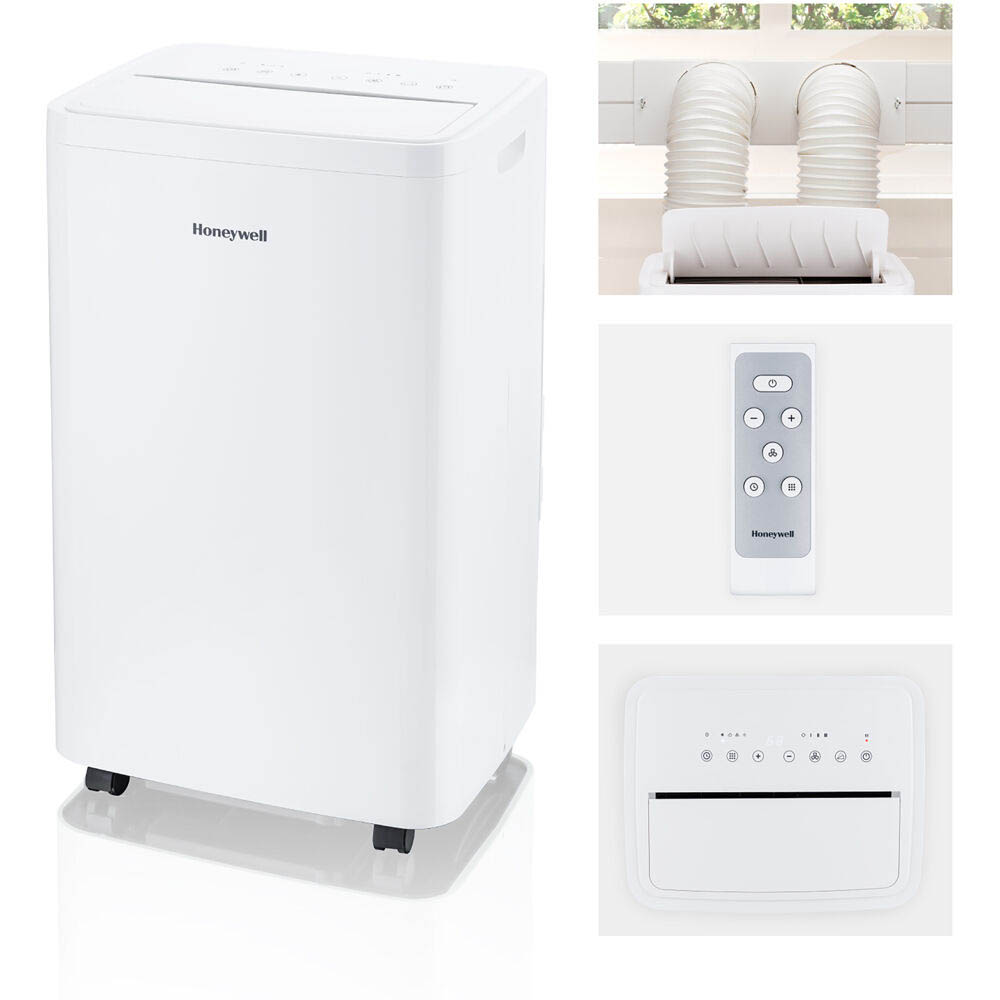
The product page, exact model manual and one-page model-coded product sheet all identify the HW4CEDAWW0 as a dual-hose machine. One duct brings outside air in and the other sends warm air out; both need a workable route to the supplied window arrangement. This is not a fit for someone expecting the compact one-hose setup used by many portables. The manual describes 5.5-inch hoses that extend 12 to 47 inches, and advises against extending them. It asks for roughly 31.5 inches of clearance at the rear and about 20 inches on the other sides. Those air-space requirements should be included in the room plan rather than measuring only the cabinet.
The exact page and model sheet list the window kit and a 19.7-to-47.2-inch bracket figure; the manual lists panel sections but does not turn those component sizes into one certain clear installed opening span. If your slider is near an endpoint, inspect the actual kit and its instructions before purchase. Do not assume the smart sibling’s different page claims, controls or size apply. The manufacturer manual says to transport the unit upright and wait at least an hour before first use. It requires a grounded connection and prohibits using an extension cord. The 51-dBA maximum is a manufacturer specification, not an independently measured sound level.
Cooling, humidity and maintenance
The AWW0 provides Cool, Dry and Fan operation, a digital control panel, remote, 24-hour timer, adjustable thermostat from 61 to 89°F, four listed fan speeds, washable dual dust filters and casters. Its product sheet lists R32 refrigerant. The licensed listing and product sheet agree on a 101-pint-per-day dehumidification claim. Cooling is described as automatic evaporation, except that high humidity can still leave water to drain. The owner manual says Dry mode requires continuous drainage; the licensed Store page says the package includes a drain pan and tube, while the manual’s equipment list does not clearly settle what tube is packed with each unit. The machine is not documented as having a lift pump. Keep hose inclusion and a guaranteed drainage route unconfirmed; if continuous Dry operation matters, verify the connector, parts and gravity routing on the actual unit before relying on it.
A one-page exact-model EnergyGuide lists CEER 7.83 and an estimated annual energy cost of $120 under its label assumptions. That is a standardized comparison label, not a prediction of your bill; hours of use, utility rates, weather, room leakage and thermostat setting change real consumption. It does allow an exact-label minimum of 7.83 to pass, unlike a generic product-page number that has no test label.
Who should consider an older AWW0?
This model is a plausible older-unit choice if 10,000 SACC meets your room requirement, you want a two-hose layout and remote rather than phone control, and the listed 59.5-pound cabinet is manageable. It does not provide heat. A hard app-control requirement or 12,000-SACC floor rules it out. A narrow window range, strict clearance or unattended Dry routine also needs direct verification: the sources do not establish every clear opening dimension or confirm that the exact drain parts are present with a used appliance. The one-year limited-warranty statement describes the original term, not whether an old unit has coverage today. Check seller identity, working condition, return rights, included hoses/window panels and written warranty status before paying. If you need a newly supported product, compare currently listed exact models rather than reading “discontinued” as a current availability signal.
Primary references: the licensed exact-model Honeywell Store listing, the model-coded HW4CEDAWW0 product sheet, its EnergyGuide, and a manufacturer-authored manual mirror whose cover names HW4CEDAWW0. The Honeywell Store’s linked manual is a different smart-model manual, so this assessment uses the exact-cover AWW0 document instead. The product image is a white packshot with a dual-hose inset; the exact association comes from the product page, not a visible cabinet code, and photo versus render is uncertain.
Key details at a glance
| DOE seasonal-adjusted cooling capacity | 10000 BTU/h |
|---|---|
| Documented modes | cool / dry / fan |
| Dual-hose exhaust arrangement | Yes |
| App or connected control | No |
| Manufacturer's lowest sound claim | 51 dBA (claim, not our measurement) |
| Combined energy efficiency ratio on EnergyGuide | 7.83 CEER |
| Cabinet width | 16.3 in |
| Cabinet height | 28 in |
| Cabinet depth | 13.6 in |
| Listed product weight | 59.5 lb |
| Listed limited warranty | 1 years |
| Built-in condensate pump | No |
| ASHRAE cooling rating (separate test method) | 14500 BTU/h |
| Supplemental heat documented | No |
Use the exact model’s instructions for operating limits, supplied equipment and version differences.
Sources for this assessment
- Honeywell Air Comfort U.S. portable-air-conditioner collection capture
- Exact licensed Honeywell Store HW4CEDAWW0 product listing
- Exact model-coded HW4CEDAWW0 product specification sheet
- Exact model-named HW4CEDAWW0 user manual, manufacturer-authored retailer-hosted copy
- Exact HW4CEDAWW0 EnergyGuide document
- Exact page-linked HW4CEDAWW0 original product image

Keep the model number in the decision.
Check the listed suffix, included vent kit, room conditions and service instructions before ordering.