
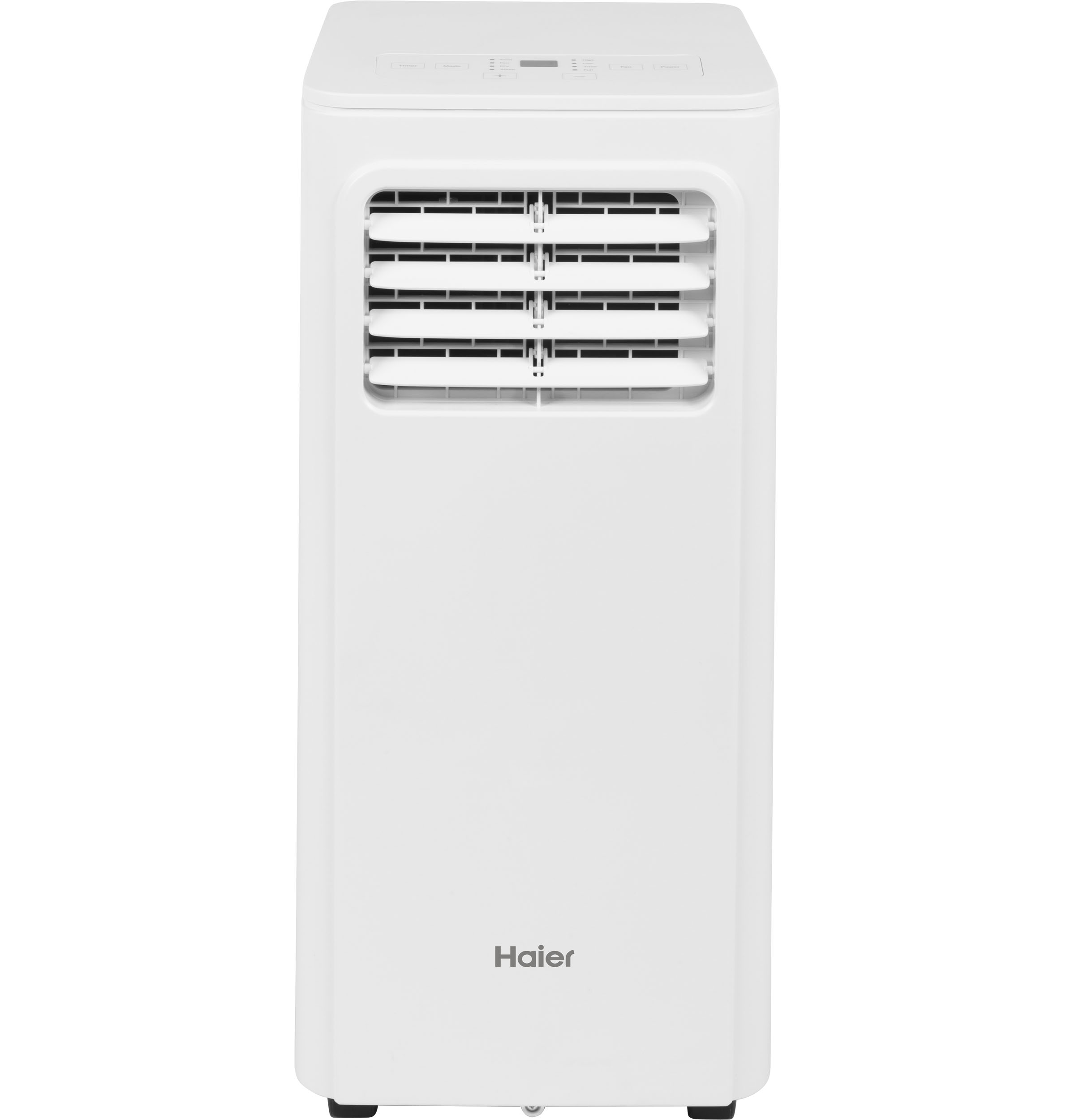
Your needs, this model
Does it fit your priorities?
Does the 6,250-BTU SACC tier meet your cooling minimum, or do you require 7,100 SACC?
Haier’s exact page title states 6,250 SACC and 9,000 ASHRAE. It meets a 6,000-SACC minimum but not a 7,100-SACC minimum.
Explore this need in the finder →Does the linked standard slider fit the clear window opening you measured?
The QPFA08/QPFA10 family manual lists a 20–46-inch opening for the standard panel, which covers 34 inches but not 47.
Explore this need in the finder →Can you install a gravity drain for Dry mode, or is a lift pump essential?
For Dry mode the manual describes a 1/2-inch-OD hose routed down to a floor drain; it does not document a lift pump.
Explore this need in the finder →Earlier Haier portable air conditioner · 6,250 BTU/h SACC
Haier QPFA10YBMW review: a higher SACC tier, but still a compact single-hose unit
The Haier QPFA10YBMW is the larger-capacity model in the QPFA08/QPFA10 family. Its exact U.S. product page labels 9,000 BTU/h ASHRAE and 6,250 BTU/h SACC separately, and estimates rooms up to 250 square feet. Use SACC when the decision is a DOE cooling minimum; the headline ASHRAE number describes a different rating method. A separate specification-table row says “Cooling BTUH (MAX)” and lists 6,100. Keep that distinct printed field in view, but do not silently replace the explicitly labelled SACC rating with it.
Haier states that QPFA10YBMW is no longer manufactured. The GE/Haier Owner Center record dates manufacture from March 2022 to June 2025. These are lifecycle facts, not a statement about current shop availability or the condition of a particular unit. For an older offer, check the model label, return window, remaining warranty terms, completeness of the kit and the machine’s history. A discontinued page can be useful for identifying an existing appliance; it is not a stock guarantee.
How it differs from QPFA08
QPFA10’s 6,250 SACC rating clears a 6,000-BTU DOE/SACC minimum, whereas QPFA08’s exact page lists 5,300. It does not clear a 7,100-SACC requirement. Haier raises its room estimate from 150 to 250 square feet, but neither number replaces room sizing: sun exposure, ceiling height, insulation, open-plan circulation, people and equipment can change the heat load substantially. Treat 250 square feet as the maker’s estimate, not a guarantee of comfort.
Both models use one exhaust hose and the same 20–46-inch sliding-window kit range. The cabinet remains close in size, but QPFA10 is listed at 26.25 inches high, 12 inches wide and 11 inches deep versus QPFA08’s 11.25-inch listed depth. QPFA10 weighs 61.7 pounds, about 3.3 pounds more than QPFA08, and its 900-watt, 8-amp specification is higher than the smaller unit’s 800 watts and 7 amps. Those are useful planning differences, not proof of superior efficiency or a predicted electric bill. The exact page lists 50/53 dBA and 60 pints per day; these are manufacturer specifications, not independent sound or dehumidification tests.
Installation still depends on the window and hose
This is not a dual-hose model. The family manual shows the standard kit spanning 20 to 46 inches and describes using the center panel with one or two side extensions as the opening grows. It does not state a separate minimum window height. Check that the clear width falls inside the documented span, that the kit’s pieces are present and that the window can close against the seal. A five-foot exhaust hose is listed; the manual cautions not to extend it or substitute a longer one. If the path cannot be arranged straight enough to reach the window, the unit has not been shown to fit your room.
Leave space for air circulation. The manual is internally inconsistent: the location instructions specify 20 inches from the exterior wall and 30 inches on the other sides, while the later installation text says 20 inches around. The conservative matching record follows the larger location-page values. Ask Haier before relying on tighter clearances. At more than 61 pounds, the casters are helpful for repositioning on a flat surface but do not solve stairs, thresholds or a raised window.
Drainage and control caveats
Cool, Dry and Fan are the listed operating modes; heat is not. Normal cooling uses the self-evaporation arrangement described by Haier, but the manual still explains the full-water warning and lower tank drain. In Dry mode, the manual directs a separate 1/2-inch outside-diameter hose from the upper port to a floor drain for extended operation. It is a gravity route and is not documented as an included hose or lift pump. If your only drain is above the unit or the appliance needs to run Dry without supervision, this exact arrangement is not a fit.
The product page lists a remote, a timer and auto-restart. Its SmartHQ promotional block appears on both QPFA product pages, but it does not provide a clear model-specific compatibility table in the detailed fields; connected control remains unknown. Treat that as unconfirmed, not a reason to choose QPFA10 over QPFA08. The washable filters should be cleaned at least every two weeks. Haier’s manual also contains R32 refrigerant safety warnings, so service and disposal should follow those instructions rather than improvised repairs.
Who should choose it?
QPFA10YBMW is a better factual fit than QPFA08 when the required threshold is at least 6,000 but below 7,100 SACC, the maker’s 250-square-foot estimate suits the room and the clear slider is within 20–46 inches. It remains a single-hose cooling appliance, not a heat pump or two-hose upgrade. Its higher weight and input are small but real tradeoffs, and its discontinued status makes seller condition and included components especially important.
Choose QPFA08 only when its 5,300-SACC tier suffices and its smaller listed weight and input help; it cannot meet the 6,000 minimum. If your hard minimum exceeds QPFA10’s 6,250 SACC, compare a model whose exact source documents at least 7,100 SACC, such as the reviewed Midea MAP08S1XWT-S, and verify its own hose, window and marketplace status. Do not infer that a similarly named Haier, a large ASHRAE headline or an area estimate resolves a rating or installation requirement.
Source basis: Haier’s exact QPFA10YBMW product page, its GE/Haier Owner Center record, the page-associated original image, and the 44-page QPFA08/QPFA10 owner manual. These are manufacturer specifications and instructions, not independent test results. Local archiving of the product-page HTML was blocked by a Cloudflare challenge; the exact page was still individually read in a browser view.
Key details at a glance
| DOE seasonal-adjusted cooling capacity | 6250 BTU/h |
|---|---|
| Manufacturer's stated room area | 250 sq ft (stated, not a guarantee) |
| Documented modes | cool / dry / fan |
| Dual-hose exhaust arrangement | No |
| Manufacturer's lowest sound claim | 50 dBA (claim, not our measurement) |
| Cabinet width | 12 in |
| Cabinet height | 26.25 in |
| Cabinet depth | 11 in |
| Listed product weight | 61.7 lb |
| Window-kit minimum width (where exact manual confirms) | 20 in |
| Window-kit maximum width (where exact manual confirms) | 46 in |
| Built-in condensate pump | No |
| ASHRAE cooling rating (separate test method) | 9000 BTU/h |
| Supplemental heat documented | No |
Use the exact model’s instructions for operating limits, supplied equipment and version differences.
Sources for this assessment

Keep the model number in the decision.
Check the listed suffix, included vent kit, room conditions and service instructions before ordering.