
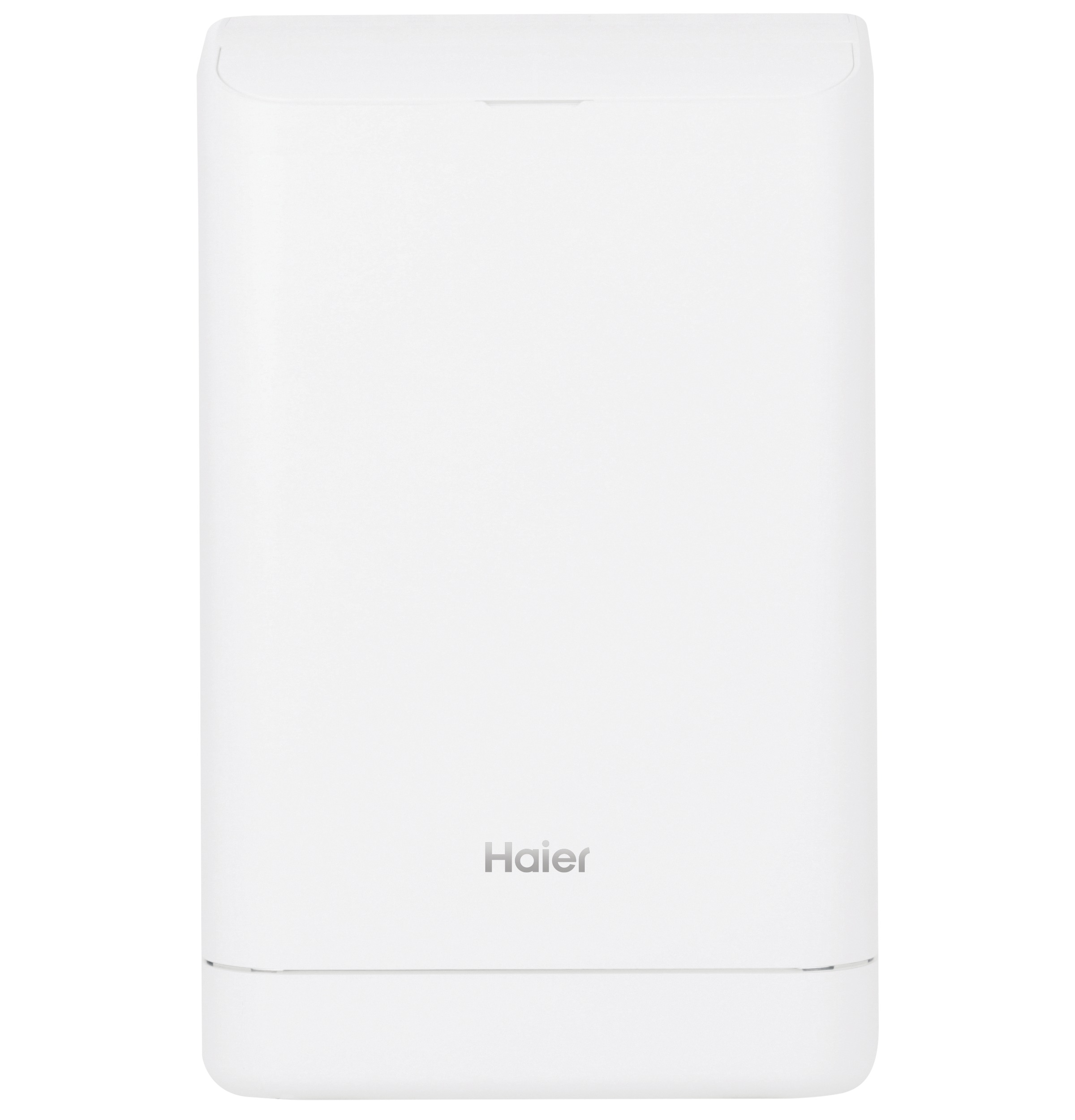
Your needs, this model
Does it fit your priorities?
Does 6,700 BTU/h SACC satisfy your cooling minimum?
Haier’s exact listing gives 6,700 SACC; this model clears the 6,000-BTU/h questionnaire tier but not the next threshold. The area estimate is not a load guarantee.
Explore this need in the finder →Will the standard uncut panel fit your measured clear opening?
Haier lists a 20–46-inch standard window-panel range. A 46-inch measured opening is within that range; 47 inches is not proven to fit. The page separately states a 4.75-inch minimum opening height.
Explore this need in the finder →Can you accept unconfirmed connected control and handle a full-water alert manually?
The detailed SKU information does not verify app compatibility or a continuous pump/gravity route. The manual describes self-evaporation under usual conditions plus a lower manual drain if the tank-full indicator appears.
Explore this need in the finder →Earlier Haier portable air conditioner · 6,700 BTU/h SACC
Haier QPCA10YZMW review: the middle QPCA capacity tier, with a real weight and plug tradeoff
Haier’s exact U.S. page lists the QPCA10YZMW at 10,000 BTU/h ASHRAE and 6,700 BTU/h SACC, with a manufacturer estimate for rooms up to 350 square feet. Use the explicitly labelled SACC value to answer DOE-capacity questions. The ASHRAE number is a different rating basis; the room estimate is not a cooling guarantee. Haier identifies this as a three-in-one portable air conditioner with cooling, fan and dehumidifying functions, not a heat-capable model.
The exact Haier page says the model is no longer manufactured. Its GE Owner Center record gives a manufacture range from March 2020 to September 2022. This can still help identify or compare a particular older unit, but it is not proof of present seller inventory, intact accessories or remaining warranty. Before considering one, check the appliance label and ask the seller exactly which window pieces, exhaust hose and remote are included.
Where QPCA10 sits between QPCA09 and QPCA12
The 6,700-SACC rating is useful when a hard requirement is at least 6,000 but below 7,100 BTU/h. The smaller QPCA09 is 5,600 SACC and misses a 6,000 minimum; the larger QPCA12 is 8,200 and can clear an 8,000 threshold. QPCA10 itself falls short of 7,100. Haier estimates 350 square feet, but sun, insulation, ceiling height, open floor plans and heat from people or electronics can change the actual load enough that area alone is a weak buying rule.
This is a useful distinction among three similarly named models: the ratings move in steps, but all retain a single exhaust hose, the same documented 20–46-inch panel span and the same family manual. QPCA10 is not the answer if your essential condition is a dual-hose intake/exhaust design or a heat pump. For a room requiring an 8,000-SACC minimum, compare a different documented model such as the current-reference Midea MAP08S1XWT-S and verify its exact fit questions rather than stretching QPCA10’s estimate.
Installation is specific—and the heavy cabinet still needs planning
The standard window kit is listed for sliding or double-hung openings 20–46 inches wide. Haier’s product specification gives a 4.75-inch minimum opening height, and the family manual describes a five-foot single exhaust hose. The manual cautions against extending that hose or using a longer substitute. Measure the opening and intended hose route before moving the cabinet; a long or sharply bent path that does not match the manual is not a confirmed fit.
QPCA10’s cabinet is 28.5 inches high, 17 inches wide and 14.1 inches deep. At 59.5 pounds, it is 7.9 pounds heavier than QPCA09. The listed input also rises from 860 watts on QPCA09 to 980 watts; those figures should not be turned into a household-cost prediction. QPCA10 is listed at 53/55 dBA low/high, slightly lower on paper than the smaller model’s 54/56, but no independent noise test is available. Haier’s manual says two people should move/install the unit and gives contradictory clearances: a location instruction requests 30 inches around the cabinet, while a later passage says 20 inches. Use the conservative 30-inch plan until the manufacturer clarifies which applies.
Plan for ordinary water handling and maintenance
Haier describes automatic evaporation as adequate under most room conditions. The manual still shows a tank-full indicator and lower manual drain, so “auto evaporation” is not equivalent to no drainage ever. The manual identifies a drainage opening but does not provide a complete, model-specific continuous gravity-hose or pump arrangement for QPCA10YZMW. Keep a shallow pan available for the documented lower-drain procedure if the indicator appears. If constant unattended dehumidification, a lift pump or a guaranteed hose-to-drain setup is essential, this exact model’s available instructions do not establish the requirement.
The spec sheet gives 65 pints per day dehumidification, 6.8 EER, 115 volts and an 8.5-amp cooling rating. It lists a 120-volt/13-amp plug-capacity field; the manual separately requires a grounded three-prong receptacle and forbids adapters and extension cords. CEER is not verified here. The washable filter should be cleaned at least every two weeks. The refrigerant is R410A, so consult the manual for service and disposal rather than treating a portable unit as a simple fan to dismantle.
Choose QPCA10 only if the 6,700-SACC tier, 350-square-foot manufacturer estimate and physical plan suit the space, and you can accept its 59.5-pound handling and older status. Choose QPCA09 for a lower load when its smaller cabinet and 5,600 SACC are enough; QPCA12 is the higher tier if 8,000 SACC is essential and its 68.3-pound mass and larger input fit your plan. Neither a similar suffix nor a product-page SmartHQ block proves app support for the exact model. Connected control remains unconfirmed; an app-essential buyer should choose an exact SKU with explicit compatibility documentation.
Two model-specific evidence cautions matter. The exact page view shows generic built-in Wi-Fi/SmartHQ content, while the family manual says Wi-Fi setup applies on some models and the 2021 catalog marks QPWA14—not QPCA10—for Wi-Fi. This SKU remains unconfirmed for app control. Its exact page says 65 pints/day dehumidification, but the older catalog says 60 in a row labeled pints/hr; keep the source claims separate rather than converting or treating either as a test.
Source basis: Haier’s exact QPCA10YZMW page, its GE/Haier Owner Center support page and the official 49-5000468 Rev. 1 family manual. The exact product page was inspected in browser-readable form; local HTML retrieval hit a Cloudflare challenge and no raw HTML archive is claimed. No customer reviews, lab measurements, personal ownership or price claims are used.
Key details at a glance
| DOE seasonal-adjusted cooling capacity | 6700 BTU/h |
|---|---|
| Manufacturer's stated room area | 350 sq ft (stated, not a guarantee) |
| Documented modes | cool / dry / fan |
| Dual-hose exhaust arrangement | No |
| Manufacturer's lowest sound claim | 53 dBA (claim, not our measurement) |
| Cabinet width | 17 in |
| Cabinet height | 28.5 in |
| Cabinet depth | 14.1 in |
| Listed product weight | 59.5 lb |
| Listed limited warranty | 1 years |
| Window-kit minimum width (where exact manual confirms) | 20 in |
| Window-kit maximum width (where exact manual confirms) | 46 in |
| Built-in condensate pump | No |
| ASHRAE cooling rating (separate test method) | 10000 BTU/h |
| Supplemental heat documented | No |
Use the exact model’s instructions for operating limits, supplied equipment and version differences.
Sources for this assessment

Keep the model number in the decision.
Check the listed suffix, included vent kit, room conditions and service instructions before ordering.